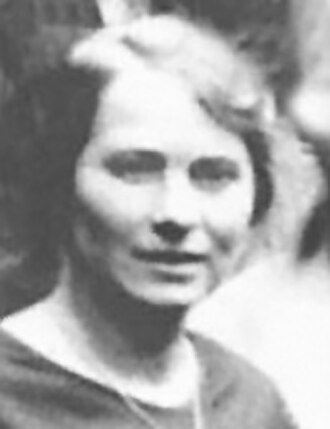
Sabina Spielrein
1885–1942 · Russian psychiatrist and psychoanalyst of Jewish origin
Sabina Spielrein (born in Rostov-on-Don in 1885, died in the Soviet Union in 1942) was a Russian psychiatrist and psychoanalyst of Jewish origin, and one of the first women to practise psychoanalysis. She is often linked to Carl Gustav Jung, who first treated her and later became involved with her personally, but her theoretical contribution stands on its own. She proposed the idea of a destructive, sadistic drive, on which Freud would later build his notion of the death drive.
She grew up in a prosperous Jewish family in Rostov, where tense relations between her parents and very demanding schooling shaped her childhood. She learned several languages and showed a restless intellect from an early age. In 1904, aged eighteen and after a severe psychological crisis, she was admitted to the Burghölzli psychiatric hospital in Zurich, led by Eugen Bleuler, where Jung treated her using psychoanalytic methods. Once recovered, she studied medicine at the university in that city and graduated in 1911 with a dissertation on the language of a patient with schizophrenia, one of the earliest psychoanalytic studies of that illness.
That same year she was admitted to the Vienna Psychoanalytic Society, the first woman to join such an association. There she presented her view that destruction is not merely the opposite of life but a force behind becoming: what breaks down makes room for something new. The work was published in 1912. In the following years she practised in Vienna, Berlin and, above all, Geneva, where she worked on education and developmental psychology, and in 1922 she analysed Jean Piaget.
In 1923 she returned to the Soviet Union, where she helped set up an experimental nursery school that was closed some years later. As the regime hardened, psychoanalysis was banned, and she continued working as a physician until 1940. She died in 1942 in Rostov, during a massacre of Jews. Her work remained in the background for decades, and she is now recognised as an original thinker who stood apart from the schools of her time.
Key ideas
- Destructive drive: destruction is a force that takes part in the emergence and transformation of the new, not merely a negative impulse.
- Child development and education: developmental psychology and pedagogy are areas where psychoanalysis can deepen our understanding of children.
- Language in schizophrenia: studying how patients speak can reveal the psychological content of the illness.
Curiosities
Jung's patient
She entered the Burghölzli hospital in 1904, and Jung was her main therapist during her stay and afterwards in the laboratory.
An unusual nursery
The White Nursery in Moscow, where she worked with Vera Schmidt, had all-white furniture and walls; Stalin is said to have enrolled his son there under a false name.
Teachers and influences
Influenced by
- Carl Jung 1875–1961
Original Filopedia text based on Wikipedia (es) and Wikipedia (en) and Wikidata.