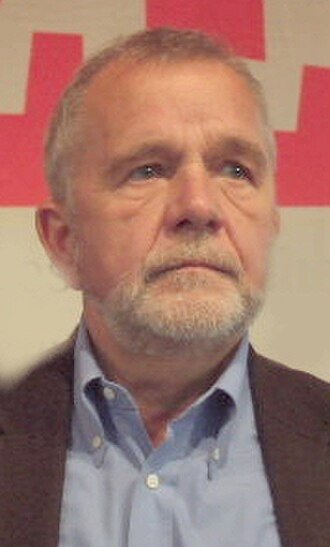
Rüdiger Safranski
b. 1945 · German philosopher and author, biographer of thinkers and poets
Rüdiger Safranski (born in Rottweil in 1945) is a German philosopher and author, best known for his biographies of thinkers and poets of the German-speaking world. His work belongs to the tradition of German philosophy after Kant, and his main contribution has been to combine careful history of ideas with a style that general readers can follow.
He studied philosophy, German literature, history and art history in Frankfurt am Main, where Theodor W. Adorno was among his teachers, and then at the Free University of Berlin, where he earned his doctorate in 1976 with a dissertation on working-class literature in West Germany. After working as an assistant lecturer and teaching adult education, he settled in Berlin in 1987 as a freelance writer.
His name is closely linked to studies of Schiller, Hoffmann, Schopenhauer, Nietzsche, Rousseau, Heidegger, Goethe and Hölderlin. Across his books he returns to questions of freedom and evil, as in Das Böse oder Das Drama der Freiheit, and to time and the art of living. His influence extends into popular philosophy in German, not least through the television debate Das Philosophische Quartett, which he co-hosted with Peter Sloterdijk.
Key ideas
- Freedom as drama: human freedom opens the possibility of evil, and Safranski treats this tension as a permanent condition rather than a problem with a final solution.
- Romanticism as a German affair: he reads Romanticism as a decisive episode in the German spirit, with its illusions, excesses and lasting consequences.
- Life as a work of art: in his reading of Goethe, existence is a form that each person shapes through choices and experience.
- The thinkable and the livable: philosophy must be judged by its power to guide concrete lives, not only by its abstract coherence.
Curiosities
A documentary on Heidegger
In 1989 he co-directed Der Zauberer von Meßkirch, a television documentary about Martin Heidegger.
A decade on television
For about ten years he co-hosted with Peter Sloterdijk the philosophy debate programme Das Philosophische Quartett on German broadcaster ZDF.
Original Filopedia text based on Wikipedia (es) and Wikipedia (en) and Wikidata.