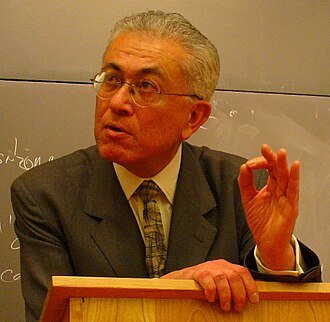
Roberto Mangabeira Unger
b. 1947 · Brazilian philosopher and politician, specialist in social theory and legal thought
Roberto Mangabeira Unger (born in Rio de Janeiro in 1947) is a Brazilian philosopher and politician, best known for his work in social theory, legal thought and political alternatives. His writing belongs to the tradition of classical Western philosophy and is often read as an effort to free people from social hierarchies and from institutional arrangements that are usually presented as unavoidable.
He has taught at Harvard Law School since 1976, when he received tenure at a notably young age. There he helped launch the Critical Legal Studies movement, which challenged the methodological consensus of American legal scholarship. His major work, Politics: A Work in Constructive Social Theory, appeared in 1987 and argues that society is a historical artifact that can be remade.
His thought holds that no social, political or economic order is natural. Property rights, liberal democracy and wage labor are historical constructions with no necessary link to a free and prosperous human life. He proposes an empowered democracy, with institutions kept open to experimentation and revision. In Brazil he has taken part in political life since helping found the PMDB, and he has served as Minister of Strategic Affairs under different governments. His influence is felt both in legal theory and in debates about institutional reform across Latin America.
Key ideas
- Society as artifact: social organization is a historical construction rather than a natural order, so it can be transformed.
- Formative context and false necessity: existing institutions seem inevitable because routines make them appear necessary, although they are contingent.
- Empowered democracy: a model of open institutions, kept open to experimentation, that lets people transform social, economic and political structures.
- Gradual change: transformation comes through accumulated struggle and proposals rather than revolutionary rupture.
Curiosities
A class with Obama
Barack Obama took part in the course «Reinventing Democracy», which Mangabeira Unger taught in the late 1980s.
An early reading of Plato
At the age of seven, his mother began reading him Benjamin Jowett's translation of Plato's Republic, an experience he identifies as the origin of his interest in speculative thought.
A dean's unanswered request
When the dean asked him to add something «of the law» to his course on Aquinas, Kant and Hegel, he refused, and by his own account no dean ever asked him for anything again.
Original Filopedia text based on Wikipedia (es) and Wikipedia (en) and Wikidata.