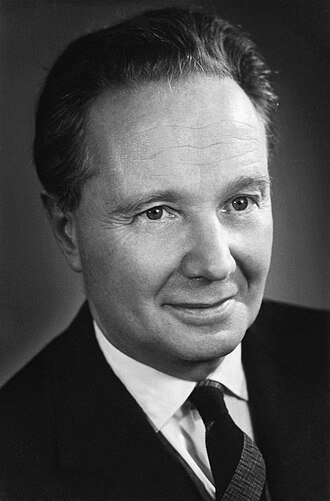
Robert Merle (1908–2004) was a French novelist whose work spans the Second World War, postwar moral fiction and the historical novel. Born in Tébessa, in French Algeria, he wrote in French and became one of the best-known storytellers of mid-twentieth-century France.
His father, an interpreter, died in 1916 at Gallipoli, and Merle moved with his mother to Paris, where he attended several lycées and studied at the Sorbonne. He taught English literature at universities and lycées before 1939. That year he was conscripted and assigned as an interpreter to the British Expeditionary Force. In 1940 he took part in the Dunkirk evacuation, and after being captured by the Germans he spent about three years as a prisoner, trying to escape once before being recaptured.
He drew on that experience for Week-end at Zuydcoote (1949), which won the Prix Goncourt and became a bestseller. His later novels moved in very different directions: the moral horror of an execution camp commander in Death Is My Trade (1952), a Cold War satire built around dolphins in A Sentient Animal (1967), and a survivors' community after a nuclear catastrophe in Malevil (1972). He also wrote plays, a biography of Oscar Wilde and translations of English classics. Until the Soviet invasion of Afghanistan he sympathized with the French Communist Party.
His most ambitious project was Fortune de France, a series of thirteen historical novels published between 1977 and 2003. It follows a Protestant doctor turned spy through sixteenth- and seventeenth-century France. Merle paid close attention to the speech rhythms and idioms of the period, which earned him a reputation as a historical novelist of real scholarly care. He was often compared to Alexandre Dumas.
Merle died in 2004. His legacy lies in showing that the war novel and the historical novel could be serious and documented without losing narrative drive. Several of his books were adapted for film and television, which carried his name beyond the circle of specialist readers.
Key works
- Week-end at Zuydcoote (1949): a Dunkirk novel told from the front line, winner of the Prix Goncourt.
- Death Is My Trade (1952): a novel about the commandant of an execution camp and his sense of obedience and responsibility.
- A Sentient Animal (1967): a Cold War satire imagining the military use of dolphins.
- Malevil (1972): a post-apocalyptic novel about survivors who rebuild a community in rural France.
Works in Filopedia
- Weekend at Dunkirk 1949
Curiosities
A box-office hit
The 1949 novel was adapted in 1964 as a film directed by Henri Verneuil and starring Jean-Paul Belmondo. It was a box-office success that made both men famous.
A blind lottery
Merle described the Dunkirk evacuation as a blind and abominable lottery, an image of chance that runs through his account of the war.
Original Filopedia text based on Wikipedia (es) and Wikipedia (en) and Wikidata.