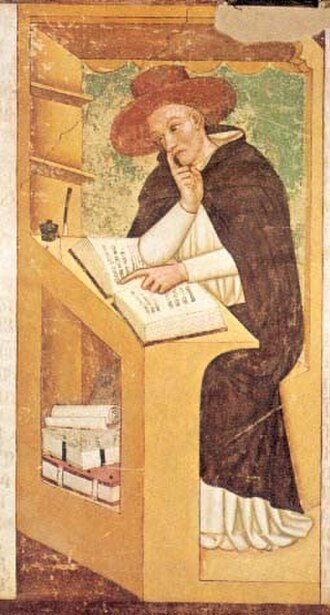
Robert Kilwardby
1215–1279 · Dominican friar, English philosopher and theologian, Archbishop of Canterbury and cardinal
Robert Kilwardby (c. 1215-1279) was an English Dominican friar, philosopher and theologian who rose to become Archbishop of Canterbury and a cardinal. He belongs to the thirteenth-century university world of England and Paris, and he was the first member of a mendicant order to reach a high ecclesiastical office in the English Church. Little is known about his early life. He studied and taught logic and grammar in Paris and, around 1250, joined the Order of Preachers. Back in England he held the chair of theology at Oxford and in 1261 was elected provincial of the English Dominicans.
In 1272 he was appointed Archbishop of Canterbury to settle a disputed election, and he was consecrated in February 1273. He crowned Edward I and Eleanor of Castile in 1274, but he kept largely out of politics and devoted himself to pastoral duties. In 1278 he was made Cardinal Bishop of Porto and Santa Rufina. He died in Viterbo the following year; rumours of poisoning circulated, though they cannot be confirmed.
His thought is a conservative and eclectic synthesis. He defended the doctrine of seminal reasons and opposed the Aristotelian view that each being has a single unity of form, including the human being. He left commentaries on logic, grammar, natural philosophy, ethics and theology, as well as sermons. His influence is most visible in the English scholastic tradition.
Key ideas
- Seminal reasons: the doctrine that things contain latent powers that develop over time, which he defended against the Aristotelian unity of form.
- Doctrinal eclecticism: a willingness to combine Augustinian and Aristotelian sources without fully committing to a single school.
- Logic as a tool of knowledge: his commentaries on Aristotle's logical works, such as the Prior Analytics, and his treatise De ortu scientiarum on the origin and classification of the sciences.
Curiosities
First friar at the top of the English Church
He was the first member of a mendicant order to reach a high ecclesiastical office in the English Church.
A departure with the archive
When he left for Viterbo he took documents from the cathedral archive and a large sum of money, leaving the see in debt again.
Original Filopedia text based on Wikipedia (es) and Wikipedia (en) and Wikidata.