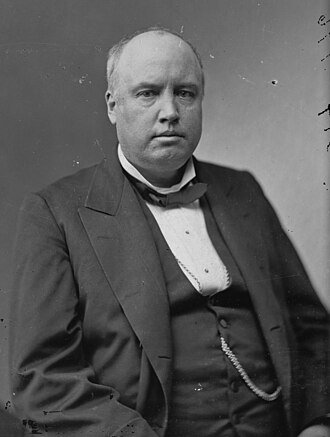
Robert Green Ingersoll
1833–1899 · American lawyer, orator and politician, known as "the Great Agnostic"
Robert Green Ingersoll (Dresden, New York, 1833 – 1899) was an American lawyer, Civil War veteran, politician and orator, nicknamed "the Great Agnostic". He belongs to the so-called Golden Age of Free Thought, a late nineteenth-century movement that championed critical judgment over religious authority. His significance lies mainly in how he brought doubt about religion and humanist ideas to a wide public, rather than in a systematic philosophical work.
He grew up in a religious household. His father, John Ingersoll, was an abolitionist Congregationalist preacher whose radical views often forced the family to move. Robert taught in several Illinois schools, studied law and, together with his brother Ebon Clarke, was admitted to the bar in 1854. He later settled in Peoria, where he built a successful practice. In 1862 he married Eva Amelia Parker, and they had two daughters; the elder, Eva Ingersoll-Brown, became a well-known feminist and suffragist.
When the Civil War broke out, he raised and commanded the 11th Illinois Volunteer Cavalry, which fought at Shiloh. After the war he served as Illinois Attorney General and was an active figure in the Republican Party, though he never held elected office. His views on religion, slavery and women's suffrage closed the way to higher posts. When Illinois Republicans proposed that he run for governor on condition that he hide his agnosticism, he refused, judging it dishonest to conceal his convictions from the public. His 1876 speech nominating James Blaine, known as the "Plumed Knight" address, is still remembered as a model of political oratory, although Blaine did not win the nomination.
As a lawyer he took part in notable cases, including the Star Route trials, in which his clients were acquitted, and he defended a New Jersey man charged with blasphemy. He did not secure an acquittal, but his forceful defence is seen as having weakened blasphemy laws. Yet his fame rests mainly on his lectures. He spoke on a wide range of subjects, though his most popular themes were agnosticism and family life. He attacked the doctrine of hell, which he described as a catalogue of human cruelty and hatred, and he defended women's rights, opposed racial discrimination and opposed capital punishment. Audiences paid unusually high admission prices for the time to hear him.
He died of congestive heart failure in 1899. His brother-in-law collected his speeches, which were published in twelve volumes, and his ashes rest in Arlington National Cemetery. He was friends with the poet Walt Whitman, who considered him the greatest orator of his age, and he delivered the eulogy at Whitman's funeral in 1892. A popular edition of his work appeared in 2005, keeping his memory alive as one of the leading American champions of free thought.
Key ideas
- Agnosticism: the view that we cannot know with certainty whether God exists, so beliefs should rest on evidence.
- Criticism of organised religion: the rejection of doctrines such as hell, which he saw as expressions of human cruelty and hatred.
- Free thought and humanism: the conviction that reason and human experience should guide moral life, not religious authority.
- Liberty and human rights: support for women's rights, opposition to slavery and racial discrimination, and rejection of the death penalty.
Books to read
- The Works of Robert G. Ingersoll, Complete Contents Dresden Edition—Twelve Volumes EnglishEPUB 4,5 MBRead online
- The Ghosts, and Other Lectures EnglishEPUB 172 KBRead online
- The Works of Robert G. Ingersoll, Vol. 12 (of 12) Dresden Edition—Miscellany EnglishEPUB 339 KBRead online
- The Works of Robert G. Ingersoll, Vol. 08 (of 12) Dresden Edition—Interviews EnglishEPUB 556 KBRead online
- The Works of Robert G. Ingersoll, Vol. 03 (of 12) Dresden Edition—Lectures EnglishEPUB 310 KBRead online
- The Works of Robert G. Ingersoll, Vol. 04 (of 12) Dresden Edition—Lectures EnglishEPUB 288 KBRead online
- The Works of Robert G. Ingersoll, Vol. 11 (of 12) Dresden Edition—Miscellany EnglishEPUB 444 KBRead online
- The Works of Robert G. Ingersoll, Vol. 01 (of 12) Dresden Edition—Lectures EnglishEPUB 299 KBRead online
- The Works of Robert G. Ingersoll, Vol. 06 (of 12) Dresden Edition—Discussions EnglishEPUB 450 KBRead online
- The Works of Robert G. Ingersoll, Vol. 09 (of 12) Dresden Edition—Political EnglishEPUB 343 KBRead online
Curiosities
A high price for the time
At the height of his fame, audiences paid one dollar or more to hear him speak, an enormous sum for the period.
Introduced as "the Great Agnostic"
In October 1880, Rev. Henry Ward Beecher introduced him in Brooklyn with that nickname, which stayed with him for the rest of his life.
He held his employer
In 1856, when the son of a political opponent shot John E. Hall in their office, where Ingersoll worked for him, Ingersoll caught Hall in his arms.
Original Filopedia text based on Wikipedia (es) and Wikipedia (en) and Wikidata.