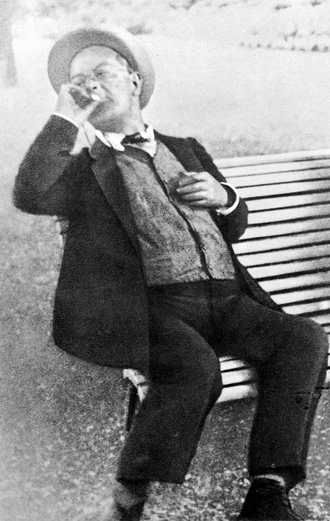
Remy de Gourmont
1858–1915 · French Symbolist writer, novelist, critic and essayist
Remy de Gourmont (born at Bazoches-au-Houlme in 1858, died in Paris in 1915) was a French writer whose work belongs to the Symbolist movement. He novelist, critic and essayist, he came of age in the late nineteenth century, when many writers looked to literature as a path to aesthetic knowledge rather than moral instruction. His influence reached Blaise Cendrars and Georges Bataille, and his essays on style were read closely by English-speaking poets. He matters most today for his thinking about writing and ideas.
He came from a Cotentin family connected to the publishing of prints and engravings. He studied law at Caen and, after graduating in 1879, moved to Paris. In 1881 he took a clerical post at the Bibliothèque nationale. His first pieces appeared in periodicals such as Le Monde and Le Contemporain, and his novel Merlette (1886) attracted little notice. That same year he discovered La Vogue and, through it, the new aesthetic currents of the day. He met Berthe Courrière, and they lived together for the rest of his life.
In 1889 he helped found the Mercure de France, which became a meeting point for Symbolist writers and where he contributed for twenty-five years. His novel Sixtine (1890) and his study Latin mystique (1892) reveal a fascination with decadent sensibility and late Latin literature. In 1891 he published a provocative essay urging cultural rapprochement between France and Germany. Its sharp tone provoked a controversy that cost him his post at the national library.
A lupus that disfigured his face pushed him away from public life, and he devoted himself almost entirely to writing. His thought rests on one central conviction: style is not decoration laid over ideas but part of their very form. In The Problem of Style and his Literary Walks he treats writing as a matter of sensitivity and precision. He distrusted settled truths, remained sceptical of moral and religious doctrines, and preferred questions to answers. His poetry, including Hieroglyphs (1894), experiments with sound and rhythm, while his novels probe the link between sexuality and artistic creation.
The last years brought progressive ataxia, which made walking increasingly difficult, and the First World War, which left him deeply discouraged. He died in Paris in September 1915. His reputation rests above all on his criticism. T. S. Eliot called him the critical conscience of his generation.
Key ideas
- Style as a form of thought: the way one writes is not ornament but part of what one thinks.
- Scepticism towards settled truths: distrust of the moral, religious and rationalist dogmas of his time.
- Problems over solutions: he preferred to explore questions rather than offer closed answers.
- Sensibility as a route to knowledge: ideas are understood through temperament and the senses, not reason alone.
Books to read
- Stories in green, zinzolin, rose, purple, mauve, lilac and orange EnglishEPUB 173 KBRead online
- Decadence, and Other Essays on the Culture of Ideas EnglishEPUB 208 KBRead online
- Philosophic Nights in Paris Being selections from Promenades Philosophiques EnglishEPUB 128 KBRead online
Curiosities
An article that cost him his job
After his 1891 essay on France and Germany he lost his post at the national library, though Octave Mirbeau defended him and secured him a place at the Journal.
Manuscripts for his brother
Berthe Courrière inherited his manuscripts and library and passed them to his brother Jean de Gourmont, who spent about ten years publishing unpublished texts.
Original Filopedia text based on Wikipedia (es) and Wikipedia (en) and Wikidata.