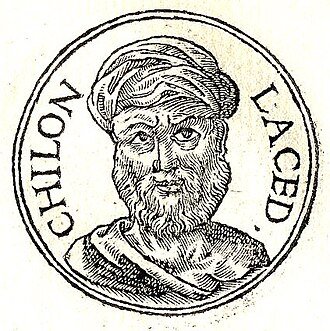
Chilon of Sparta
599 BC–519 BC · Spartan politician and one of the Seven Sages of Greece
Chilon of Sparta (c. 599-519 BC) is remembered as one of the Seven Sages of Greece, but above all as a Spartan politician who left a lasting mark on the organisation of his city. He lived at the beginning of the sixth century BC, in the Archaic period, and his name belongs both to the institutional history of Sparta and to the moral tradition of Greek thought. He matters because he combines two roles: the statesman and the author of short maxims that circulated for centuries.
According to the sources, he was the son of Damagetus and served as ephor, the magistrate whose task was to oversee the kings. Diogenes Laertius places his election around 556/555 BC and claims that he was the first to establish the custom of ephors sitting alongside the kings as their counsellors. He is credited with much of the constitution traditionally attributed to Lycurgus, and with turning the ephorate into the supreme magistracy of the Spartan state. He is also seen as a driving force behind the militarisation of civilian life and the first measures of military training for young people.
In foreign affairs he took a firm line against Arcadia, whose cities were subdued by Sparta. Tegea kept its independence and became the most loyal of Sparta's allies in the Peloponnese. Some accounts link him to the overthrow of the tyranny at Sicyon, which then joined Sparta, and to the development of the Peloponnesian League. He also wrote elegiac verse, of which mainly sayings survive.
His thought is best known through his maxims: do not speak ill of the dead, honour old age, restrain anger, do not mock someone in misfortune, obey the laws, and be merciful if you are strong. A saying attributed to him, that laconising means philosophising, captures the Spartan ideal of brevity as a form of wisdom. He is also traditionally linked with the Delphic maxim 'Know thyself', although the attribution is disputed, since other sages and even Apollo himself appear in different accounts as its source.
His influence was mainly moral and symbolic. His sayings were quoted and copied, became part of Greek education, and turned him into a model of political prudence. Tradition holds that he died of joy when his son won a prize at the Olympic Games.
Key ideas
- Brevity: saying only what is needed and not letting the tongue outrun judgement, an attitude the Spartans made part of their way of life.
- Self-control: restraining anger and not desiring the impossible as conditions for living sensibly.
- Strength joined to mercy: whoever holds power should earn the respect of neighbours rather than only their fear.
- Respect for laws and elders: obeying the law and honouring the old as pillars of common life.
Curiosities
A death from joy
According to a legend, he died of joy when his son won the boxing prize at the Olympic Games. His funeral was said to have been attended by all the Greeks gathered at the festival.
A royal descendant
One of his descendants married King Anaxandridas II of Sparta, and their son was King Cleomenes I.
A mocking inscription
An inscription at the Bath of the Seven Sages in Ostia says that the cunning Chilon taught people to fart silently.
Original Filopedia text based on Wikipedia (es) and Wikipedia (en) and Wikidata.