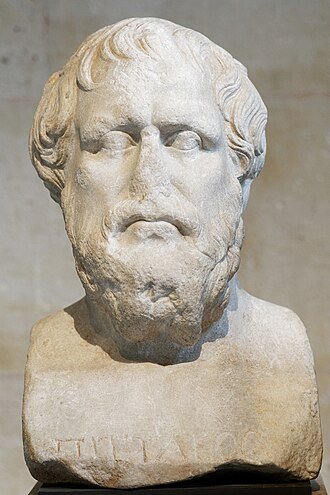
Pittacus of Mytilene
650 BC–570 BC · Mytilenean statesman and soldier, one of the Seven Sages of Greece
Pittacus of Mytilene was a Greek statesman and military leader from Mytilene, the main city of the island of Lesbos. He lived roughly between the seventh and sixth centuries BC, in the Archaic period, and tradition counts him among the Seven Sages of Greece. His lasting significance lies less in a philosophical system than in his views on power, law and prudence, which show how good government was imagined in the Greek cities of his time, when the rule of a small elite was increasingly contested.
According to the sources, he was the son of Hyrradius and married into the Pentilidae, one of the most powerful families on the island. Around 612 BC he took part in local politics alongside Antimenidas and Cicis, brothers of the poet Alcaeus, to overthrow the tyrant Melanchrus. He later switched sides and supported Myrsilus, the next tyrant, which turned him into a rival of Alcaeus, who opposed the new ruler and became one of his sharpest critics in verse.
His name is also tied to the war with Athens over Sigeion, a headland in the Troad that had once been a Mytilenean colony. Pittacus is said to have defeated the Athenian commander Phrynon in single combat, trapping him with a net concealed beneath his shield before killing him. After an arbitration by Periander of Corinth, Sigeion remained in Athenian hands, while Achilleion passed under Mytilenean control. When Myrsilus died, around 590 BC, the citizens chose Pittacus as aisymnetes, an elected and non-hereditary office that gave him power for about ten years. At the end of that term he resigned, and the city was said to have enjoyed good order and lasting laws.
His reputation as a lawgiver rests on a rule that doubled the penalty for crimes committed while drunk, a measure that probably fell hardest on aristocrats, who were more often guilty of violent excess. Later writers also credited him with verses and a spurious letter to Croesus, though none of these texts survives with any certainty. He lived past seventy and died around 568 BC.
His legacy lies chiefly in the sayings attributed to him. He held that being truly good is hard, that even the gods cannot overcome necessity, and that power reveals the character of the person who holds it. Their place among the Seven Sages and their constant quotation in later tradition gave him a lasting influence on Greek reflection about political prudence.
Key ideas
- Political prudence: governing means anticipating troubles and enduring them when they arrive.
- Punishment and pardon: mercy may be better than punishment, as the anecdote about his murdered son suggests.
- The difficulty of virtue: being truly good is hard, and he did not regard it as easy.
- The limits of necessity: not even the gods can resist what is necessary.
- Law against drunkenness: crimes committed while intoxicated should be punished more severely.
Curiosities
The duel with Phrynon
According to Polyaenus and other sources, Pittacus hid a net beneath his shield and used it to trap the Athenian general before killing him.
Pardon over punishment
Tradition holds that when the murderer of his son was brought before him, Pittacus freed him, saying that pardon is better than punishment.
Original Filopedia text based on Wikipedia (es) and Wikipedia (en) and Wikidata.