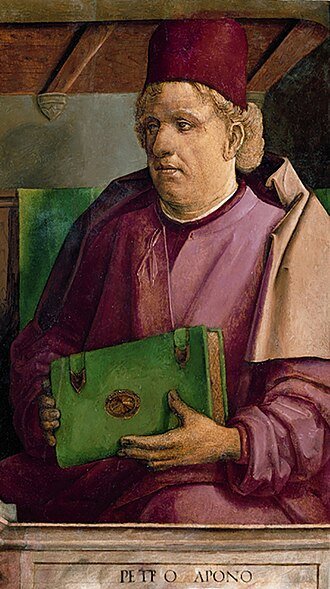
Pietro d'Abano
1250–1316 · Italian physician, astrologer and philosopher of the University of Padua
Pietro d'Abano (c. 1250-1316) was an Italian physician, astrologer and professor, and a central figure of the so-called Paduan school. Born in the town that now bears the name Abano Terme, he is also known as Petrus de Apono or Aponensis. His main work, the Conciliator differentiarum quae inter philosophos et medicos versantur, sought to reconcile Arabic medicine with Aristotle's natural philosophy, and for centuries it remained a standard reference in universities.
He studied in the East and in Constantinople, where he learned Greek. Around 1300 he moved to Paris, where he took degrees in philosophy and medicine and enjoyed considerable success as a physician, though he charged very high fees. There he began to run into trouble with the Inquisition. In 1306 he returned to Padua, where his medical reputation grew and where he was accused of practising magic, among other things because of rumours that he possessed the philosopher's stone. His writings expounded the medical and philosophical systems of Averroes, Avicenna and other Islamic authors, and tried to resolve the apparent contradictions between medical theory and Aristotelian physics. He addressed touch and smell, linking the nerves to the heart as the central organ of sensation.
In his work on healing, d'Abano held that only matter can act on the body, so he denied that God, angels or demons directly intervened in cures. He did not deny, however, the apparent effectiveness of prayers and charms; he attributed it to a bond of trust between the healer and the patient. He also believed in astral magic and ascribed to the heavenly bodies what others attributed to spirits.
In 1314 the papal Inquisition accused him of heresy, and he faced two trials. He died before they concluded, in 1316 by the usual dating, and was condemned posthumously: his body was to be exhumed and burned, but friends hid it, so the Inquisition had to content itself with burning his effigy. His influence on Renaissance medicine was considerable, and his work on poisons and their remedies also circulated widely.
Key ideas
- Reconciling medicine and philosophy: he tried to harmonise Arabic medicine with Aristotle's physics, resolving the apparent contradictions between them.
- Trust as the source of healing: the effectiveness of prayers and charms would lie not in their religious content but in the trust between healer and patient.
- Material healing: only matter can act on the body, so he rejected any direct intervention by God, angels or demons in cures.
- Astral magic: he attributed to the stars the influences on health and phenomena that others explained by spirits.
Curiosities
"The Great Lombard"
In Paris he was known as "the Great Lombard", a nickname reflecting his Italian origin and his fame in the city.
A sentence carried out in effigy
After his death, friends hid his body to prevent its burning, so the Inquisition settled for burning an effigy of him.
Original Filopedia text based on Wikipedia (es) and Wikipedia (en) and Wikidata.