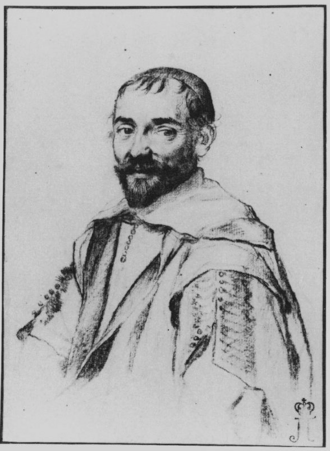
Pierre Gassendi
1592–1655 · French priest, philosopher and astronomer, reviver of Epicurean atomism
Pierre Gassendi (1592-1655) was a French Catholic priest, philosopher, astronomer and mathematician who lived in the first half of the seventeenth century, when scholastic learning was giving way to the new science. He is remembered as one of the main restorers of atomism and Epicureanism, and his importance lies in seeking a middle path between scepticism and dogmatism, grounded in experience and mathematical reasoning, while remaining a believing Christian.
Born at Champtercier, near Digne, in Provence, into a peasant family, he was educated by his uncle, the priest Thomas Fabry. He studied philosophy at Aix-en-Provence and theology at Avignon, and was ordained in 1615. For years he combined his church duties as a canon at Digne with teaching. In 1617 he took the chair of philosophy at the University of Aix, but in 1623, when the Jesuits took control of the institution, he had to leave. That same year he met Marin Mersenne in Paris, beginning a lasting friendship that opened the doors of the learned circles of the time.
His first major work, the Exercitationes paradoxicae adversus Aristoteleos (1624), published anonymously, criticised the dogmatic use of Aristotle by the scholastics and called for a philosophy attentive to observation. After travelling through Flanders and the Netherlands, he returned to France and settled at Digne, where he kept close ties with his patron Nicolas-Claude Fabri de Peiresc until Peiresc's death in 1637. He wrote a biography of Peiresc, published in 1641. In 1645 he obtained a chair of mathematics at the Collège Royal in Paris, which he had to give up in 1648 because of ill health.
Gassendi argued that atoms, understood along the lines of Epicurus and Democritus, were created by God, so that matter could be explained mechanically without denying divine providence. This earned him the nickname of the 'Christianised Epicurus'. As a scientist he observed the sky with the telescope, and in 1631 he was the first to record the transit of Mercury predicted by Kepler, which showed that the planet was much smaller than had been believed. He also stated the law of inertia correctly, measured the speed of sound with remarkable accuracy for his time, and studied atmospheric pressure.
His relationship with Descartes was strained. In 1641 he raised objections to the Meditations, questioning whether certain knowledge of the mind could be separated from sensory experience, and reproaching Descartes for a dualism that left the relation between soul and body unresolved. He died in Paris in 1655, in the house of Henri Louis Habert de Montmor. His influence reached the Enlightenment, especially through the revival of Epicurus and his defence of an empirical and mechanistic method, and through figures such as his disciple François Bernier.
Key ideas
- Christianised atomism: matter is made of atoms that move according to mechanical laws, and God is their creator and ordainer.
- Moderate empiricism: knowledge rests on observation and experience, without giving up mathematical reasoning.
- A middle way: against radical scepticism and dogmatism, he proposes a probable but reliable knowledge built from the senses.
- Criticism of Aristotelianism: he calls for examining Aristotle without treating him as an unquestionable authority.
- Epicurean ethics: he upholds moderate pleasure and tranquillity of mind as the aims of human life.
Curiosities
First recorded transit
In 1631 he observed the transit of Mercury across the Sun, the first such observation on record, as Kepler had predicted.
A crater named after him
A large crater on the Moon bears his name in honour of his astronomical work.
Teachers and influences
Influenced by
- Epicurus 341 BC–269 BC
Influenced
- Gottfried Wilhelm Leibniz 1646–1716
Original Filopedia text based on Wikipedia (es) and Wikipedia (en) and Wikidata.