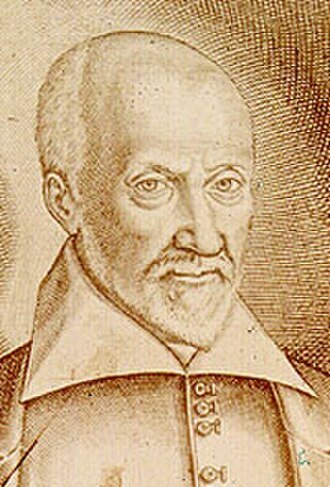
Pierre Charron
1541–1603 · French theologian and philosopher, a representative of skepticism and Baroque libertinism
Pierre Charron (Paris, 1541 – 1603) was a French theologian and philosopher, a disciple and friend of Michel de Montaigne. He is usually placed among the skeptics and libertines of the seventeenth century, a current that combined doubt about human knowledge with a defence of the faith. That combination is why his work matters both to historians of the Counter-Reformation and to readers interested in the origins of modern thought.
The son of a bookseller, he studied at the Sorbonne and then law at Orléans and Bourges. He practised as an advocate for a few years before entering the Church, where he became a popular preacher. His longest stay was in Bordeaux, where he formed a close friendship with Montaigne; when Montaigne died in 1592, Charron was asked in his will to bear the Montaigne arms. He later held church posts in Cahors and Condom, and died in 1603 after a stroke, during a journey to Paris.
His best-known work, Les Trois Vérités (1594), is a treatise against the Calvinists that defends the existence of God and the truth of Catholic Christianity. Charron argues that God's nature lies beyond human reason, so we can know him only by negation, and he also attacks atheists, whose definitions of God he considers mistaken. In De la sagesse (1601), which draws heavily on Montaigne, he argues that no one reaches the whole truth through reason alone, since the senses and reason are fallible. He proposes a free and unprejudiced examination that leaves the mind ready to receive Revelation. Meanwhile, the wise person follows a provisional morality based on nature, separate from religion, which makes him a forerunner of ethics as an independent philosophical discipline.
In his lifetime he enjoyed a reputation comparable to Montaigne's. His fideism was useful to some defenders of the Counter-Reformation, while his critics accused him of atheism. His work gained further importance after 1620.
Key ideas
- Christian Pyrrhonism: it combines Pyrrho's doubt with the negative theology of the mystics, so that we know of God only what he is not.
- Limits of reason: the senses and reason are fallible, so supernatural truths depend on Revelation.
- Method of doubt: examine everything freely and without prejudice to clear the mind of uncertain opinions.
- Morality apart from religion: the wise person follows the principles of nature while waiting for divine grace.
Curiosities
A large family
According to the sources, Charron was born in Paris as one of twenty-five children of a bookseller.
Accused of atheism
The Jesuit François Garasse attacked De la sagesse and described Charron as an atheist, an accusation the book did not dispel.
Original Filopedia text based on Wikipedia (es) and Wikipedia (en) and Wikidata.