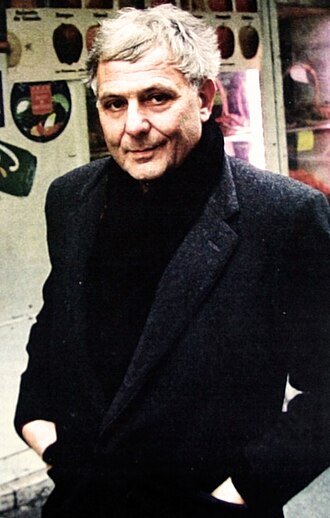
Philippe Sollers
1936–2023 · French writer, editor and critic, central figure of Tel Quel
Philippe Sollers, born Philippe Joyaux in Talence in 1936 and who died in Paris in 2023, was one of the most controversial French writers of the second half of the twentieth century. His name is tied to the journal Tel Quel, founded in 1960, through which he championed writers who were then unknown or deeply contested, and to a long career as novelist, essayist and editor that ran alongside structuralism, post-structuralism and the intellectual life of Paris.
Raised in a prosperous bourgeois family linked to an iron factory, he studied economics and was expected to run the business, but a growing commitment to literature, encouraged by the poet Francis Ponge, won out. His first novel, published in 1958, drew praise from Aragon and François Mauriac. He then experimented with narrative form. In books such as The Park, Drame and Nombres he dropped conventional punctuation to free the rhythm of the text; later, with Femmes, he returned to a more figurative style, shaped by Céline and American writers.
His thought centres on individual freedom against the family, the school, the army and political parties, and on an idea of art grounded in creation and pleasure. In his wide-ranging essays he traced a history of art through music, painting and literature, and his prose drew freely on Spinoza, Freud, Nietzsche and Debord. He married the psychoanalyst Julia Kristeva in 1967. His lasting mark lies mainly in French literary journals and publishing, although his novels are now read less than his public persona, which was built on provocation.
Key ideas
- Individual freedom: Sollers saw writing as a way of escaping the institutions that control and limit life.
- Formal experimentation: dropping punctuation and using the cut-up aimed to free expression from conventional language.
- Art as creation and pleasure: he defended a history of art and literature based on the individual, invention and enjoyment.
- Dialogue with tradition: his texts engage Dante, Sade, Proust, Nietzsche and Heidegger as living interlocutors.
Curiosities
An early endorsement
His first novel, published in 1958, was praised by Louis Aragon, although Sollers later downplayed its value himself.
A rejected bestseller
As a series editor at Gallimard in 1992, he turned down Amélie Nothomb's first successful novel, which was later published by Albin Michel.
Original Filopedia text based on Wikipedia (es) and Wikipedia (en) and Wikidata.