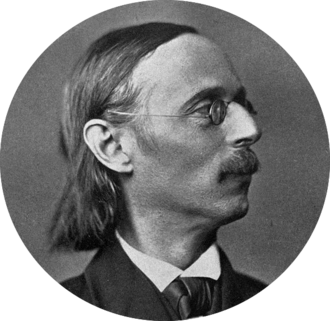
Peter Cornelius
1824–1874 · German composer, poet and translator
Carl August Peter Cornelius (Mainz, 1824 – Mainz, 1874) was a German composer, poet and translator of the nineteenth century, linked to the opera world and to the circle around Liszt and Wagner. He is remembered mainly for his comic opera The Barber of Baghdad.
The son of actors, he learned the violin and began writing songs before studying composition with Heinrich Esser from 1841. From 1844 to 1852 he lived in Berlin with his uncle, the painter Peter von Cornelius, and met figures such as Alexander von Humboldt, the Brothers Grimm and Mendelssohn. There he also wrote music criticism and befriended Eichendorff and Hans von Bülow.
His first major works were written in Weimar between 1852 and 1858, close to Franz Liszt, who advised him to expand The Barber of Baghdad into two acts. He then spent five years in Vienna, where he met Wagner, and in 1864 moved to Munich at Wagner's suggestion. There he married and had four children. His relationship with the so-called New German School was uneven; he skipped the premiere of Tristan und Isolde.
His music shows the influence of Berlioz in the comic scenes of his opera, which is sung throughout with no spoken dialogue. For Der Cid he sought a personal style apart from Wagner, drawing on the Castilian hero Rodrigo Díaz de Vivar. His last opera, Gunlöd, was left unfinished when he died of diabetes in Mainz in 1874; it was completed by others and premiered in Weimar in 1891.
His legacy is modest but lasting. Mainz's conservatory has carried his name since 1936, and his archive is open to researchers. In Britain his best-known piece is the carol 'The Three Kings', from his Weihnachtslieder.
Key works
- Stabat mater (1849), for soloists, chorus and orchestra, one of his first large-scale works.
- Weihnachtslieder (1856), a cycle of Christmas songs that includes 'The Three Kings'.
- The Barber of Baghdad (1858), a comic opera in two acts with his own libretto based on the Arabian Nights.
- Der Cid (1865), a lyric drama in three acts drawing on Corneille and the figure of Rodrigo Díaz de Vivar.
Curiosities
A scandalous premiere
The premiere of *The Barber of Baghdad* in Weimar in December 1858 drew protests against Franz Liszt, who resigned as court kapellmeister after the performance. The opera was not staged again during Cornelius's lifetime.
A British carol
The melody of 'The Three Kings' accompanies the chorale tune 'Wie schön leuchtet der Morgenstern', written by Philipp Nicolai in 1597. The English translation by H. N. Bate, from 1928, is the version that became popular in Britain.
Original Filopedia text based on Wikipedia (es) and Wikipedia (en) and Wikidata.