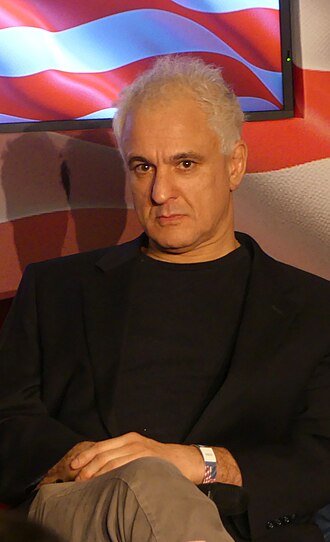
Peter Boghossian
b. 1966 · American philosopher and educator
Peter Boghossian (born in Boston, 1966) is an American philosopher and educator known for his work on atheism, critical thinking and the Socratic method. For ten years he was an assistant professor of philosophy at Portland State University, which he left in 2021, citing harassment and a lack of intellectual freedom.
His books A Manual for Creating Atheists (2013) and, with James Lindsay, How to Have Impossible Conversations (2019) set out his proposals. Boghossian argues that faith is an unreliable way of knowing and that religious beliefs can be examined through patient, non-confrontational questioning. He coined the phrase 'street epistemology' to describe this approach.
He also drew wide public attention through the grievance studies affair, in which he and his collaborators submitted deliberately absurd papers to academic journals to test their peer-review processes. The project won both praise and methodological criticism. His influence is felt mainly in debates about popular atheism and academic freedom.
Key ideas
- Street epistemology: a set of conversational techniques that aim to examine deeply held beliefs, especially religious ones, without confrontation.
- Faith as an unreliable way of knowing: beliefs based on faith should not be accepted without scrutiny, and criticism should focus on that foundation rather than on religious communities.
- The Socratic method and critical thinking: guided questioning as a tool to challenge assumptions and, in his doctoral research, to foster moral reasoning.
Curiosities
Immigrant grandparents
He is of Armenian descent, and his paternal grandparents were Armenian immigrants.
A paper quoting Mein Kampf
In the grievance studies affair, one paper accepted by the feminist social work journal Affilia mixed up-to-date jargon with passages taken from Adolf Hitler's Mein Kampf.
Original Filopedia text based on Wikipedia (es) and Wikipedia (en) and Wikidata.