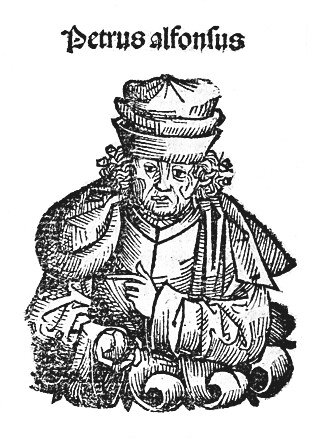
Petrus Alphonsi
1062–1140 · Spanish writer, theologian and astronomer of Jewish origin
Petrus Alphonsi, born Moses Sephardi, was a writer, polemicist and astronomer from Islamic Spain who later became a Christian and spent much of his later life in England and France. He was baptised in Huesca, in the Kingdom of Aragon, on St Peter's Day, 29 June 1106, with King Alfonso I as his godfather, and took the name Petrus Alfonsi. His education in Hebrew, Arabic and the sciences gave him a rare command of three religious traditions, and this shaped nearly everything he later wrote.
By 1116 at the latest he was in England, where by his own account he taught the liberal arts and astronomy, served as physician to Henry I and worked on Arabic astronomical tables with Walcher of Malvern. He later moved to northern France. The dates of his birth and death remain unknown, and he is last securely documented in the 1120s.
His writing combines debate with moral instruction. The Dialogus contra iudaeos argues for Christianity from inside Jewish learning, drawing on the Talmud and the Torah, and it takes a more patient, teaching tone than many rival polemics. His Latin fable collection, Disciplina clericalis, gathers tales from Arabic, Persian and Indian sources together with moral proverbs, and it became one of the most widely read story collections of the Middle Ages. Later writers, among them Boccaccio, Don Juan Manuel and Cervantes, borrowed from it.
His legacy is mixed. He helped carry Eastern storytelling into Christian Europe and passed on Arabic astronomy and the astrolabe. His attack on the Talmud, however, became a model for later anti-Jewish polemic, which is why historians still study him closely.
Key works
- Disciplina clericalis (c. 1106-1110), a collection of 33 moral tales of Eastern origin.
- Dialogus contra iudaeos (after 1106), a polemical dialogue between a Jew and a Christian, in which the author speaks as both his former and present selves.
- Epistula ad peripateticos Francos (c. 1120), a letter on the value of arithmetic and the liberal arts.
- De Dracone (c. 1116-1120), a treatise on calculating the movements of the stars.
Works in Filopedia
Curiosities
A name with a godfather
He took the name Petrus Alfonsi, honouring St Peter, on whose feast day he was baptised, and his godfather, King Alfonso I of Aragon.
A book that reached Cervantes
His *Disciplina clericalis* was translated into several European languages and supplied stories later used by writers such as Boccaccio and Don Juan Manuel.
Original Filopedia text based on Wikipedia (es) and Wikipedia (en) and Wikidata.