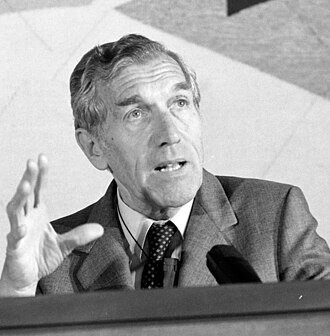
Paul Watzlawick
1921–2007 · Austrian-American psychologist, communication theorist and philosopher
Paul Watzlawick (Villach, 1921 - Palo Alto, 2007) was a psychologist, communication theorist and philosopher, born in Austria and later a naturalized American. He is a central figure in human communication theory, radical constructivism and family and systemic therapy, and his influence still shapes contemporary psychotherapy.
He studied philosophy and philology at the University of Venice, where he earned his doctorate in 1949, and then trained in analytical psychology at the Carl Jung Institute in Zurich, qualifying in 1954. After a period of research at the University of El Salvador, Don Jackson invited him in 1960 to join the Mental Research Institute in Palo Alto, California, where he spent the rest of his career. From 1967 he taught psychiatry at Stanford University. At the MRI he worked in the tradition of Gregory Bateson and the team that developed the double bind theory of schizophrenia, which located the roots of disorder in contradictions within communication.
His best-known book, Pragmatics of Human Communication, written in 1967 with Janet Beavin and Don Jackson, sets out five axioms. The first holds that one cannot not communicate, since every behaviour, even silence, carries meaning. The second separates content from relationship, with the relationship aspect framing the content. The third describes communication as a circular process in which each party reacts to the other and tends to see the other as the cause. The fourth distinguishes digital from analogue modes, words from tone and gesture. The fifth contrasts symmetrical relationships between equals with complementary ones based on power.
Watzlawick argued that much of the reality we perceive is constructed, and that our attempts to fix problems can keep them going. These ideas, also developed in the MRI's Brief Therapy Center, shaped family therapy, brief therapy and constructivism, and they remain standard reading in communication studies and psychotherapy.
Key ideas
- One cannot not communicate: every behaviour, silence included, carries communicative meaning.
- Content and relationship: a message says something and also signals how the speakers relate to each other.
- Punctuation of sequences: each party sees the other's behaviour as the cause of its own, even though interaction is circular.
- Digital and analogue communication: words convey content, while tone and gesture convey the relationship.
- Symmetrical and complementary relationships: relations between equals tend toward mirrored behaviour, while those based on authority tend toward complementarity.
Original Filopedia text based on Wikipedia (es) and Wikipedia (en) and Wikidata.