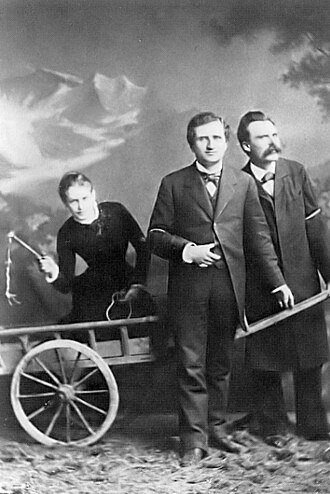
Paul Rée
1849–1901 · German philosopher of the nineteenth century, friend of Nietzsche
Paul Rée (1849–1901) was a German philosopher of the later nineteenth century, working within the naturalist and positivist climate of his time. He is remembered mainly for his friendship with Friedrich Nietzsche rather than for a philosophical work of the first rank.
Born in Bartelshagen, in Prussian Pomerania, into a wealthy and assimilated Jewish family, he studied philosophy and law at Leipzig. He served in the Franco-Prussian War of 1870 and was wounded at Saint-Privat. In 1875 he qualified for his doctorate at Halle with a dissertation on the noble in Aristotle's ethics, and the same year he published Psychological Observations, a collection of aphorisms on human nature.
In The Origin of the Moral Sensations (1877) he argued that altruism is an innate tendency, strengthened by selection and passed on through habit. Like Darwin and Lamarck, he sought natural causes for morality rather than metaphysical principles, and he rejected free will. Nietzsche criticised the book in the preface to On the Genealogy of Morals, though he admitted reading it closely and without ill-humour. Their friendship broke down in 1882, partly because of Lou Andreas-Salomé. Rée died in 1901 after falling into a ravine in the Swiss Alps near Celerina. His own influence was modest, but his work helps explain the intellectual setting in which Nietzsche wrote.
Key ideas
- Innate altruism: compassion and helping others would be an inherited tendency that selection gradually reinforced.
- Naturalised morality: moral feelings are explained by natural causes and the history of the species, not by metaphysical essences of good and evil.
- Inheritance of habits: following Lamarck, acquired habits could be passed on and eventually become innate traits.
- Critique of free will: the idea of a free will is an error that, in Rée's view, helped produce the feeling of justice.
Curiosities
Wounded at Saint-Privat
During the Franco-Prussian War he was conscripted and wounded in the early fighting at the battle of Saint-Privat on 18 August 1870.
A fall in the Alps
He died after falling into the Charnadüra gorge in the Swiss mountains near Celerina. Nietzsche's biographer Rüdiger Safranski considers it unclear whether it was an accident or suicide.
A remark about his vocation
Shortly before his death he declared: “I have to philosophize. When I run out of material about which to philosophize, it is best for me to die.”
Teachers and influences
Influenced
- Friedrich Nietzsche 1844–1900
Original Filopedia text based on Wikipedia (es) and Wikipedia (en) and Wikidata.