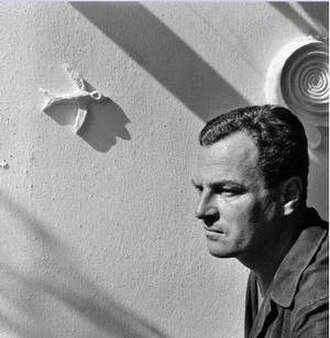
Patrick Leigh Fermor
1915–2011 · British writer, historian and soldier
Patrick Leigh Fermor (London, 1915 – Worcestershire, 2011) was a British writer, historian and soldier, widely regarded as one of the finest travel writers of the twentieth century. During the Second World War he played a prominent part in the Cretan resistance against the German occupation, an experience that gave him a lasting reputation before his books did.
Born in London to a geologist father who worked in India, he was largely raised by a family in Northamptonshire and later struggled with the rigid routines of school, leaving The King's School, Canterbury. He educated himself through Greek, Latin, Shakespeare and history. At eighteen, in December 1933, he set out on foot from the Hook of Holland towards Constantinople. He wrote about that journey decades later, drawing on everything he had learned in the meantime, which gave the books their depth of history, language and anthropology. After spells in Greece and Romania, he enlisted when war broke out and served as a liaison officer in Albania and then on Crete. Disguised as a shepherd, he spent more than two years in the mountains and led the party that in 1944 captured and evacuated the German commander, General Heinrich Kreipe, an episode later filmed as Ill Met by Moonlight (1957).
After the war his first book, The Traveller's Tree (1950), about the Caribbean, won a major literary prize and launched his career. Other books followed on the Peloponnese and mainland Greece, where he mixed landscape, history and conversations with local people. His prose is long-breathed, precise and full of allusion, and it rests on an unusual memory and a lifelong interest in languages. A Time of Gifts (1977) is often considered among the best travel books written in English.
His influence can be seen in a generation of British travel writers, including Bruce Chatwin, Colin Thubron and Rory Stewart. He spent his later years between Kardamyli, on the Mani Peninsula, and Gloucestershire, and died in 2011 before completing the third volume of his trilogy about Europe in the 1930s.
Key works
- The Traveller's Tree (1950): an account of his travels in the Caribbean after the war, with close attention to the legacy of slavery.
- Mani: Travels in the Southern Peloponnese (1958): a journey on foot and by mule through the Mani peninsula in Greece.
- A Time of Gifts (1977): the story of his walk of 1933 towards Constantinople, widely admired as a masterpiece of the genre.
- Between the Woods and the Water (1986): the second part of the trilogy about that journey.
- The Violins of Saint-Jacques (1953): his only novel, later adapted as an opera by Malcolm Williamson.
Curiosities
An expulsion from school
He was expelled from The King's School, Canterbury, after he was caught holding hands with a greengrocer's daughter.
A famous description
A BBC journalist once called him 'a cross between Indiana Jones, James Bond and Graham Greene'.
Original Filopedia text based on Wikipedia (es) and Wikipedia (en) and Wikidata.