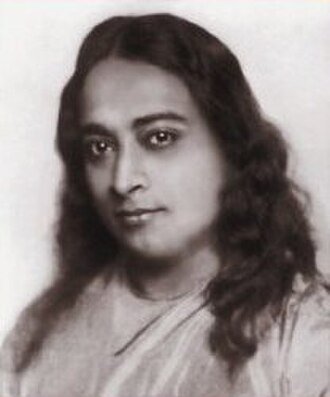
Paramahansa Yogananda
1893–1952 · Hindu yogi and guru, pioneer of yoga in the West
Paramahansa Yogananda (Gorakhpur, 1893 - Los Angeles, 1952) was a Hindu yogi and guru who brought Kriya Yoga and meditation to the West as a path to direct experience of God. Born into a well-off Bengali family as Mukunda Lal Ghosh, he belonged to the tradition of yoga and reformed Hinduism that flourished in India at the turn of the twentieth century, when the country was increasingly in dialogue with the Western world. He matters because he was one of the first Hindu teachers to settle permanently in the United States, and because his influence on American yoga, especially in Los Angeles, has lasted.
As a young man he searched among India's sages and saints for a teacher. At seventeen he met Sri Yukteswar Giri, who became his guru for a decade. After a university degree in Serampore, he formally took monastic vows in 1915 as a swami, taking the name Yogananda Giri. In 1917 he founded a school for boys in Bengal that combined modern teaching methods with yoga, an enterprise that later grew into the Yogoda Satsanga Society of India.
In 1920 he travelled to the United States as India's delegate to a congress of religious liberals in Boston, and there he founded the Self-Realization Fellowship (SRF). For several years he lectured along the East Coast and then toured the country. In 1925 he established the organization's headquarters in Los Angeles, at Mount Washington, which remained the centre of his work. He lived in America from 1920 until his death, apart from a trip to India in 1935 and 1936, during which he received the title Paramahansa.
His central teaching holds that true religion rests on intuitive experience rather than blind faith. He taught that people suffer because they identify themselves with the body, the name and the place of birth, instead of recognising themselves in God, whom he likened to the producer of a film in which each person plays a role that changes with each reincarnation. Kriya Yoga and meditation were, in his view, the means to reach that understanding, which he called self-realization. He also described samadhi as a state of expanded consciousness in which the body is suspended, though he stressed that it is reached only after long practice.
His best-known work, Autobiography of a Yogi (1946), was a publishing success and has been translated into many languages. It has continued to reach readers from many backgrounds and is still in print. His legacy lives on in the SRF and the Yogoda Satsanga, and he is regarded as an important figure in bringing Eastern spirituality into Western culture.
Key ideas
- Direct experience over blind faith: true religion rests on intuition and experiential knowledge of God.
- Self-realization: the awareness of one's own being, which contains in latent form union with God.
- Kriya Yoga: a practice of meditation and active devotion that leads to that union.
- The world as a film: human life is a role in a divine drama, and suffering arises from identifying only with the body.
Books to read
- Autobiography of a Yogi EnglishGutenberg
Curiosities
A title of distinction
Sri Yukteswar gave him the monastic title Paramahansa, meaning 'spiritual swan', which signals the highest level of spiritual realization.
A meeting with Gandhi
According to his Autobiography of a Yogi, during his 1935 visit to India he met Mahatma Gandhi, who later became his disciple.
Original Filopedia text based on Wikipedia (es) and Wikipedia (en) and Wikidata.