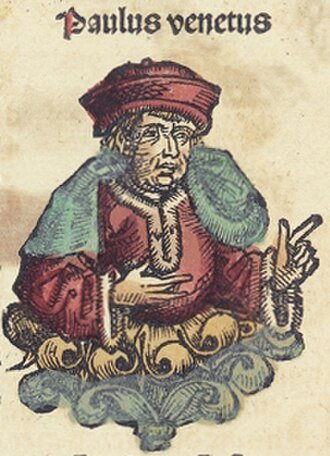
Paul of Venice
1369–1429 · Venetian philosopher, theologian and logician of the Augustinian Order
Paul of Venice (Paulus Venetus, 1369–1429) was a philosopher, theologian and logician of the Order of Saint Augustine, and a leading figure of the so-called Paduan school. Probably born in Udine, he spent most of his life in Venice, where he died in 1429.
He joined the Augustinians at fourteen. After a period of theological study at Oxford, which he apparently cut short, he finished his training at the University of Padua and became a doctor of arts and theology in 1405. He taught at Padua, Siena, Perugia and Bologna, and in 1409 was named prior general of his order. In 1427 he was summoned to Rome to help defend the orthodoxy of St Bernardino of Siena.
His thought belongs to the medieval realist tradition. He drew heavily on Duns Scotus, upholding the univocity of being and the existence of universal forms independently of the mind, and he refined the relation between essence and being. He also argued with the nominalists of his day, such as William of Ockham and John Buridan, often playing their positions against one another. His large output, which includes commentaries on Aristotle, the Logica Magna and a natural philosophy summa, shows a keen interest in the science of his time. He died while completing his commentary on the De anima.
Key ideas
- Univocity of being: the word "being" is applied in one and the same sense to God and creatures, which grounds the unity of metaphysics.
- Realism about universals: universal forms exist independently of the mind that thinks them.
- Thisness: the principle that individuates each thing is its "thisness", inherited from Scotist thought.
- Formal distinction: between essence and being there is a distinction that is neither real nor merely mental, taken from Scotus and reworked by Paul.
Original Filopedia text based on Wikipedia (en) and Wikidata.