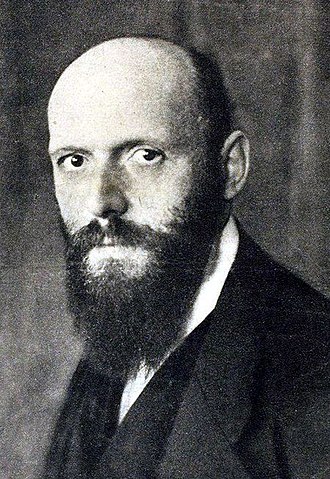
Otto Neurath
1882–1945 · Austrian philosopher of science, economist and sociologist, member of the Vienna Circle
Otto Neurath (Vienna, 1882 – Oxford, 1945) was an Austrian-born philosopher of science, sociologist and political economist, and one of the leading figures of the Vienna Circle. Often described as one of the neglected thinkers of the twentieth century, he belonged to the logical empiricist movement but departed from it in important ways, above all in his interest in the social role of knowledge and in the idea that science is a collective, practical enterprise. He is also remembered for inventing the ISOTYPE method of pictorial statistics.
He studied mathematics, physics, economics, history and philosophy, and took his doctorate in Berlin in 1906 with a thesis on ancient views of trade, crafts and agriculture. During the First World War he directed a department of war economy in the Austrian War Ministry. After the war he took part in socialist economic planning in Germany and was briefly involved in the Bavarian Soviet Republic, for which he was imprisoned. In interwar Vienna he worked on social housing and public education, and developed ISOTYPE, a system of picture symbols meant to let ordinary readers grasp complex figures at a glance.
In philosophy, Neurath argued that science should form a unified whole and that metaphysics had to be rejected unless its claims could be translated into verifiable statements. Yet he parted ways with some of his colleagues on key points. He held that protocol statements should be impersonal and public rather than first-person reports, and in works such as Physicalism he argued that truth is not a matter of matching sentences to facts but of coherence within a system of accepted statements. This holistic view shaped the thinking of Willard Van Orman Quine.
He left Austria in 1934, settling first in the Netherlands and then, after the German invasion, in Britain, where he taught at Oxford until his sudden death in 1945. His wife, Marie Reidemeister, carried on his work at the Isotype Institute. His legacy lives on in the philosophy of science, in the history of data visualisation and in the unity of science movement.
Key ideas
- Unity of science: the aim of a single body of knowledge bringing together the various sciences.
- Coherence: the truth of a statement depends on its relation to the body of already verified statements, not on a direct match with facts.
- Protocol statements: reports of experience are impersonal and public, not subjective first-person pronouncements.
- Rejection of metaphysics: only propositions translatable into verifiable statements are admissible.
- Visual statistics: data can be communicated through pictograms that ordinary readers can understand without technical language.
Curiosities
A slogan on the wall
Neurath hung his own coinage on the wall of his office at the Vienna museum: “Words divide, pictures unite.”
A coded telegram
According to his second wife's account, in 1934 he received a telegram reading “Carnap is waiting for you”, which led him to travel to The Hague instead of Vienna.
Teachers and influences
Influenced by
- Ernst Mach 1838–1916
Original Filopedia text based on Wikipedia (es) and Wikipedia (en) and Wikidata.