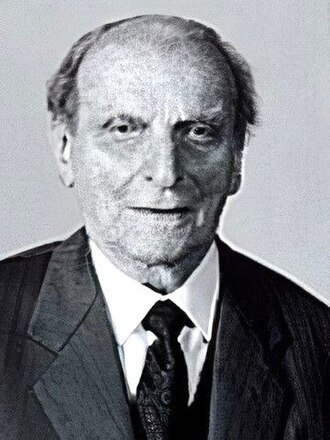
Norberto Bobbio
1909–2004 · Italian jurist and political philosopher, theorist of liberal socialism and democracy
Norberto Bobbio (Turin, 1909 – Turin, 2004) was an Italian jurist, philosopher of law and political scientist, and one of the most influential Italian intellectuals of the twentieth century. His work belongs to the tradition of liberal socialism, with roots in Piero Gobetti and Carlo Rosselli, and it focused on the connections between democracy, rights and constitutional order.
The son of a surgeon, he grew up in a well-off family with sympathies for fascism. As a student he joined the National Fascist Party, but over time he distanced himself from the regime. After graduating in law and philosophy in Turin, he taught philosophy of law at Camerino, Siena and Padua, before returning to his native city, where he remained until his retirement. During the Second World War he joined the anti-fascist resistance, first through the Partito d'Azione and then through Giustizia e Libertà, and he was imprisoned in 1943. After the war he stood in the 1946 Constituent Assembly elections without success and withdrew from active politics to focus on scholarship and cultural life.
His early work engaged with phenomenology and existentialism, which he later abandoned, partly because of their distance from political questions and partly because he saw in phenomenology a return to metaphysics. He then moved toward logical empiricism and analytic philosophy. In the 1950s he defended Hans Kelsen's pure theory of law against natural law theorists and Marxists, and he developed a structural account of the legal order. From the 1970s his attention shifted toward political theory, with works such as Which Socialism? and The Future of Democracy.
Bobbio argued that democracy is best understood as a set of rules establishing who may take collective decisions and by what procedures. He defended peaceful alternation in power, the rule of law and the separation of powers. He also drew the distinction between left and right according to attitudes toward inequality, and he criticised both the authoritarian tendencies of much Marxism and the corruption and terrorism that marked Italian public life. His influence endures in debates about democracy, rights and peace.
Key ideas
- Democracy as a set of rules: democracy is defined by the procedures that determine who decides and how, rather than by a fixed substantive content.
- Liberal socialism: the pursuit of social equality must coexist with individual liberties and constitutional order.
- The left-right distinction: the left seeks to combat social inequality, while the right tends to regard much of it as natural and unavoidable.
- Rule of law: power must be limited and divided, and public decisions must be subject to law.
- Democracy, rights and peace: these three ideals are inseparable and form the core of his political thought.
Curiosities
From fascism to anti-fascism
Bobbio joined the National Fascist Party as a young man, but later took part in the anti-fascist resistance and was imprisoned in 1943.
A man of Turin
He was born and died in Turin, the city where he lived most of his life.
Original Filopedia text based on Wikipedia (es) and Wikipedia (en) and Wikidata.