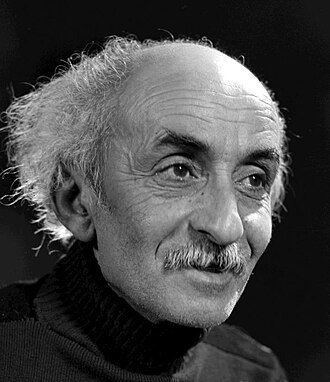
Nima Yushij
1895–1960 · Iranian poet, father of modern Persian poetry
Nima Yushij, born Ali Esfandiari, was an Iranian poet who wrote in Persian as well as in Mazandarani, the language of his home region. He lived through the late Qajar period and the early decades of modern Iran, and he is regarded as the father of modern Persian poetry.
He was born in Yush, a village in Mazandaran province, to a family of Tabari origin with Georgian roots on his mother's side. As a boy he helped on the family farm and went along with shepherds to their summer and winter camps. The stories told around the campfire, about village and tribal conflicts, stayed with him for life.
He was a restless pupil at the maktab in his village. At twelve he was sent to Tehran, to the St. Louis School, where the poet Nezam Vafa took him under his wing and encouraged his talent. The contrast between traditional schooling, rural life and the urban setting fed his imagination.
At first he wrote in the manner of Saadi and Hafez, but he gradually adopted new devices. His long poem The Tale of the Pale-Colored One, published in 1921, drew sharp criticism from traditionalist poets who mocked his break with classical models.
His main change was to the rhythm: the length of a line was governed by the weight of its thought rather than by the fixed meter that had shaped the bayt since the early days of Persian poetry. He used language close to everyday speech and symbols that give the poem its structure. Social themes took the place once held by the beloved.
Many of his works reached the public late, because the state-controlled press would not print them. He died in 1960 in Shemiran, north of Tehran, and, as he had wished, was buried in Yush.
His legacy is known as Nimaic verse, or she'r-e now, meaning new poetry. Most major Iranian poets of the mid-century adopted some element of his style.
Key works
- The Tale of the Pale-Colored One (1921): a long poem that first brought him public attention and clashed with defenders of classical poetry.
- O Night (1922): a transitional poem printed in the weekly Nowbahar.
- The Phoenix (1938): one of the works usually cited as the start of his poetic revolution.
- The Crow (1938): published alongside The Phoenix in the journal Musiqi.
Curiosities
A difficult pupil
At the maktab, the teacher often had to look for him in the streets, bring him to class and punish him.
Buried in his village
Following his will, he was buried in Yush, the village where he was born.
A poem in a song
The singer Ali Azimi used one of his poems, titled "When Crying Begins", as part of the hit song "Tamume Chiza".
Original Filopedia text based on Wikipedia (es) and Wikipedia (en) and Wikidata.