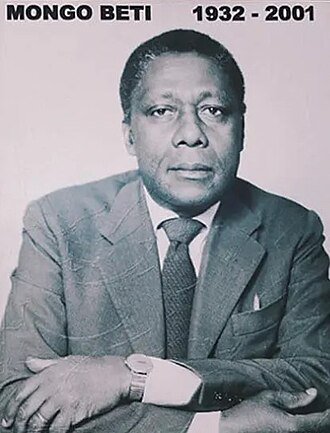
Alexandre Biyidi Awala, known as Mongo Beti (1932-2001), was one of the most perceptive French-language African writers of the independence generation. Born in Cameroon, he spent much of his adult life in France, yet his attention stayed fixed on his home country. His work, moving between the novel and political essay, remains a key reference for understanding colonialism and its aftermath.
He was born in 1932 in Akométan, a small village near Mbalmayo, about 45 kilometres from Yaoundé. His father drowned when he was seven, and he was raised by his mother and extended family. At home and at school he encountered the ideas of independence leader Ruben Um Nyobe, and his outspokenness got him expelled from a mission school. After graduating in 1951 he went to France to study literature, first at Aix-en-Provence and then at the Sorbonne.
His early writing appeared in the early 1950s in the journal Présence Africaine. With Le Pauvre Christ de Bomba (1956), a biting satire of the missionary and colonial world, he gained wide notice, and the novel was banned in Cameroon. After Nyobe's assassination in 1958 he fell silent as a novelist for more than a decade. He returned in 1972 with the essay Main basse sur le Cameroun, which argued that France still controlled its former colonies in all but name. With his wife, Odile Tobner, he founded the review Peuples noirs. Peuples africains in 1978, and his later work mixed fiction with direct criticism of postcolonial governments.
In 1991 he returned to Cameroon after more than thirty years in exile and, once retired, settled there permanently. His legacy lies in a realist literature devoted to the dignity of African peoples and in his insistence that independence should mean real freedom, not merely a change of flag.
Key works
- Le Pauvre Christ de Bomba (1956): a satire of the missionary and colonial world, banned in Cameroon.
- Remember Ruben (1974): a novel about Ruben Um Nyobe, the first part of a trilogy.
- Main basse sur le Cameroun (1972): a critical essay on decolonisation and Cameroon's continued dependence on France.
- Trop de soleil tue l'amour (1999): a late novel focused on social life in Cameroon.
Works in Filopedia
Curiosities
A banned novel
*Le Pauvre Christ de Bomba* was banned in Cameroon after pressure from the religious hierarchy.
Expelled for his views
He was expelled from the missionary school in Mbalmayo for his outspoken political opinions, as he recalled.
Original Filopedia text based on Wikipedia (es) and Wikipedia (en) and Wikidata.