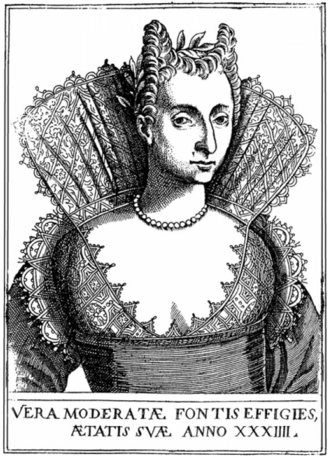
Moderata Fonte
1555–1592 · Venetian writer and poet of the late Renaissance
Moderata Fonte, the literary name of Modesta Pozzo, was a Venetian writer of the late Renaissance who wrote in Italian. She lived from 1555 to 1592 in the Republic of Venice, and today she is remembered as one of the first authors to make a written case for the worth of women, at a time when nearly all such texts were signed by men.
She lost both parents to the plague when she was still a baby and was raised by her maternal grandmother and that woman's second husband, Prospero Saraceni, a man of letters whose library gave her the chance to study on her own. Her brother Leonardo also taught her Latin and other subjects that, as a woman, she could not learn at school. As a child she was admired for her memory, and it is said that she could repeat long sermons after hearing them only once.
Her first known work is Il Floridoro (1581), a chivalric epic poem. She also wrote a musical piece for a festival before the Doge and religious poems in ottava rima on the Passion and Resurrection of Christ, in which the women who follow Jesus play a prominent part. She married the lawyer Filippo de' Zorzi and kept writing after her marriage, which was unusual for the period.
Her best-known work, Il merito delle donne, is a dialogue in which a group of women talk in a Venetian garden about their lives with men. Against the misogynist tradition, the speakers claim women's intellectual abilities and the need for women to be educated, although the text stops short of demanding full equality. Fonte died in 1592, aged thirty-seven, giving birth to her fourth child, and the book appeared posthumously in 1600.
Her reputation was recovered mainly in the twentieth century, thanks to Italian and American scholars who saw in her a forerunner of modern feminist ideas, such as the view that many differences between men and women are cultural rather than biological. Her other dialogue, Giustizia delle donne, also published after her death, is considered even more daring in its critique of men.
Key works
- Il Floridoro (1581), a chivalric epic poem that made her known in Venetian literary circles.
- La passione di Cristo (1582), an ottava rima religious poem on the death of Christ.
- Le feste (1582), a musical work performed before the Doge of Venice.
- Il merito delle donne (1600), a posthumous dialogue defending the intellectual and moral worth of women.
Curiosities
A prodigious memory
According to her biographer, she could repeat long sermons she had heard only once, which is why she was displayed as a child prodigy at the convent where she studied.
The returned dowry
A document dated October 1583 records that her husband returned her dowry about a year and a half after the wedding, an uncommon gesture for the time.
A Latin epitaph
Her husband had a marble epitaph placed on her tomb describing her as femina doctissima, a very learned woman.
Original Filopedia text based on Wikipedia (es) and Wikipedia (en) and Wikidata.