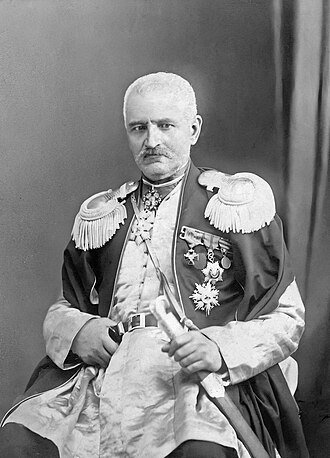
Mirza Fatali Akhundov
1812–1878 · Azerbaijani writer, playwright and enlightenment thinker of the Russian Empire
Mirza Fatali Akhundov, also known as Akhundzade, was an Azerbaijani writer, playwright, literary critic and atheist thinker, born in 1812 in Nukha, the capital of the Shaki Khanate, and active for most of his life under the Russian Empire. He is regarded as one of the founders of modern Azerbaijani literature and as a key figure of the Enlightenment in the Caucasus and in contemporary Iran.
After Russia occupied his region, he grew up in Nukha and Ganja, where his uncle Haji Ali Asghar, who had adopted him, arranged his education with a view to a clerical career. In Ganja he met the mystic Mirza Shafi Vazeh, whose conversations turned him away from that path. In 1834 he settled in Tiflis, where he worked as a translator of Oriental languages for the Russian administration and as a teacher, and where contact with exiled Decembrists and Armenian writers shaped his Europeanised outlook.
Around the early 1850s he wrote six comedies, regarded as the first comedies in Azerbaijani literature, in which he satirised the society of his time. In 1859 he published the short novel The Deceived Stars, an early example of realistic historical prose in his language. His plays were translated into Persian and helped shape the birth of modern Iranian theatre.
His thought combined religious criticism and atheist materialism with the belief that Russian rule could bring modernisation to the Caucasus. He proposed replacing the Perso-Arabic script used for Azerbaijani with the Latin alphabet. Although he described his kinsmen as Turkic, he considered Iran his homeland, and his praise of the pre-Islamic past of Iran places him among the forerunners of modern Iranian nationalism. His influence reached Persian writers such as Malkum Khan and Mirza Aqa Khan Kermani, and Turkish intellectuals of the late nineteenth and early twentieth centuries.
Key ideas
- Literary realism: literature should depict society as it is, with critical distance rather than idealisation.
- Materialism and atheism: the world is explained by natural causes, and institutional religion appears as an obstacle to progress.
- Script reform: Azerbaijani should be written in the Latin alphabet to make education and culture more accessible.
- Criticism of polygamy and the oppression of women: the practice of having several wives harms women and children alike.
- Iranian nationalism and modernisation: Iran's pre-Islamic past is a source of greatness, and Russian rule could drive progress in the Caucasus.
Curiosities
An African ancestor
According to his biographers, his mother's lineage included an African ancestor who served under the Iranian shah Nader Shah, a connection Akhundov felt linked him to the Russian poet Alexander Pushkin.
The «Azerbaijani Molière»
A German magazine of foreign literature called him a «dramatic genius» and «the Azerbaijani Molière», a praise that reflects how his comedies were received beyond his country.
Original Filopedia text based on Wikipedia (en) and Wikidata.