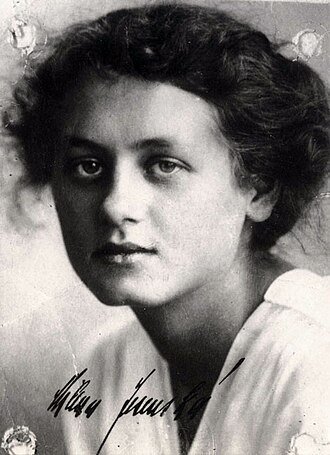
Milena Jesenská
1896–1944 · Czech journalist, writer and translator
Milena Jesenská (Prague, 1896 – Ravensbrück, 1944) was a Czech journalist, writer and translator who worked in German and Czech. For many years she was known mainly as the woman who corresponded with Franz Kafka, yet her own work as a reporter and editor is the more lasting part of her story, as is her resistance to the Nazis.
She was born into a educated family in Prague; her father was a surgeon and professor at the university. She began medicine at his urging but soon gave it up. Against her father's opposition she married the writer Ernst Pollak and moved to Vienna, where she earned money by translating and teaching Czech. In 1919 she read Kafka's story "The Stoker" and wrote to ask permission to translate it into Czech, the first translation of his work into that language. Their correspondence grew intense, and their few meetings were brief; the relationship faded around 1920.
In Vienna she began writing for Prague newspapers, producing reports on everyday city life, working conditions and the situation of women. After her divorce she returned to Prague, married the architect Jaromír Krejcar and had a daughter. She joined the Communist Party, but her criticism of Stalinism and of the party's subservience to Moscow led to her expulsion in the mid-1930s. In 1938 and 1939 she edited the cultural and political weekly Přítomnost, where she warned about Nazi expansion.
After the German occupation she joined the underground, helping Jews and refugees escape from the Protectorate. The Gestapo arrested her in 1939, and after prisons in Prague and Dresden she was sent to Ravensbrück in 1940. There she supported fellow prisoners and befriended Margarete Buber-Neumann, who later wrote her biography. She died of kidney failure in May 1944.
Her legacy rests on her sharp, original journalism, her role as the first translator of Kafka into Czech and her courage under occupation. She is honoured as Righteous Among the Nations and remembered in many tributes, including a street in Sabadell, Spain.
Key works
- Milena's Recipes (Milenovy recepty, 1927): a collection of cooking advice drawn from questions sent in by her readers.
- The Road to Simplicity (Cesta k jednoduchosti, 1927): a collection of her journalism.
- The Monk Makes the Habit (Člověk dělá šaty, 1927): another collection of her reports and articles.
Curiosities
The nickname 4711
Her prisoner number at Ravensbrück was 4714, but other inmates nicknamed her "4711", a reference to a well-known German brand of eau de cologne.
A star she did not need
As a form of provocation, she walked the streets wearing a yellow star even though she was not of Jewish origin.
Original Filopedia text based on Wikipedia (es) and Wikipedia (en) and Wikidata.