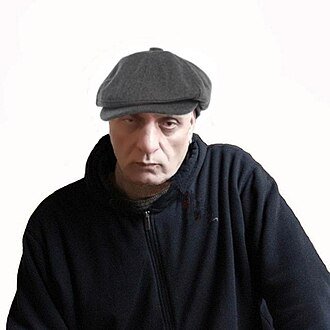
Mikho Mossulishvili (Miho Mosulishvili in English, მიხო მოსულიშვილი in Georgian) is a Georgian writer born in 1962 in Arashenda, in the Kakheti region. He works in novels, short stories, plays and essays written in Georgian, and his output belongs to the literary debate in Georgia after independence, blending local tradition with contemporary currents. No date of death appears in the available sources.
He studied geology at Tbilisi State University and for years worked as a geologist and as a journalist for several newspapers. Alongside this, he published stories and novels and translated works by the Russian author Boris Akunin into Georgian. His plays were staged in Georgia, and some of his books have appeared in English, German, Armenian and Russian. His uncle, the physicist Liguri Mosulishvili, is cited as an influence on the way he thinks.
His best-known work is the picaresque novel Flight Without a Tun, which follows Georgian and Nigerian emigrants in Germany. He also wrote Vazha-Pshavela, a biographical book about the Georgian poet, in which he argues that the poet's five epic poems follow the golden ratio and draw on Georgian mythology, placing the poet in a wider frame than the national one. He wrote the script for a documentary about King David IV, directed by Géorge Ovashvili.
His writing is associated with post-postmodernism and metamodernism, and he has won Georgian literary prizes over the past two decades, including the Saguramo Prize in 2024. His legacy lies mainly in contemporary Georgian literature, where prose, theatre and literary biography meet.
Key works
- Flight Without a Tun (2001), picaresque novel about Georgian and Nigerian emigrants in Germany.
- Vazha-Pshavela (2011), biography of the Georgian poet and reading of his epic poems.
- The Swans Under the Snow (2004), collection of stories.
Works in Filopedia
- A Big She-Bear 2013
Curiosities
A physicist uncle
Sources cite his uncle, the physicist Liguri Mosulishvili, as an influence on his way of thinking and on his creative work.
The golden ratio in Vazha-Pshavela
In his biography of Vazha-Pshavela, the author argues that the poet's five epic poems are based on the golden ratio, presenting this as his own observation.
Teachers and influences
Influenced by
- Hermann Hesse 1877–1962
- Samuel Beckett 1906–1989
- Ryūnosuke Akutagawa 1892–1927
- Vazha-Pshavela 1861–1915
Original Filopedia text based on Wikipedia (es) and Wikipedia (en) and Wikidata.