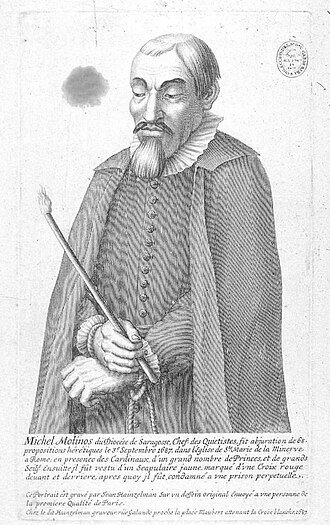
Miguel de Molinos
1628–1696 · Spanish mystic and theologian, chief figure of Quietism
Miguel de Molinos (born 1628 near Muniesa, in Aragon, died in Rome in 1696) was a Spanish Catholic mystic and the leading representative of Quietism, a movement the Church eventually condemned. His teaching is sometimes called Molinism in Spanish, though it should not be confused with the older Molinism of Luis de Molina.
He was educated by the Jesuits in Valencia, where he was ordained and worked as a confessor to a community of nuns. In the 1660s he went to Rome to promote the beatification cause of Francisco Jerónimo Simón, and he never returned to Spain. There he became an influential spiritual director. In 1675 he published his Spiritual Guide, arguing that the soul should rest in a quiet, passive state, leaving aside active effort and discursive meditation. Its ideas alarmed the Jesuits, and in 1685 he was arrested by the Inquisition. After a long trial he abjured his errors in 1687 and received a life sentence, which Pope Innocent XI confirmed in the bull Coelestis pastor.
His book found far more readers abroad than in Spain, appearing in several European languages. The debate it provoked reached France, and in the twentieth century writers such as Aldous Huxley, the poet José Ángel Valente and the philosopher María Zambrano returned to his work.
Key ideas
- Quietism: spiritual perfection consists in an inner stillness in which the soul stops striving to earn merit.
- Passivity before God: human activity disturbs the reception of grace, so the will should be held in suspension.
- Annihilation and inner emptiness: the soul's self-emptying is presented as the shortest route to union with God.
- Criticism of meditation: discursive meditation and sensible devotions are placed below silent contemplation.
Curiosities
A character in Huxley
Aldous Huxley drew on his ideas in the novel After Many a Summer (1939), in which the character Bill Propter discusses supposed letters by Molinos.
Compared with Buddhism
In his Dictionnaire historique et critique (1697), Pierre Bayle compared Quietism with the Buddhist pursuit of nirvana in order to discredit it.
Original Filopedia text based on Wikipedia (es) and Wikipedia (en) and Wikidata.