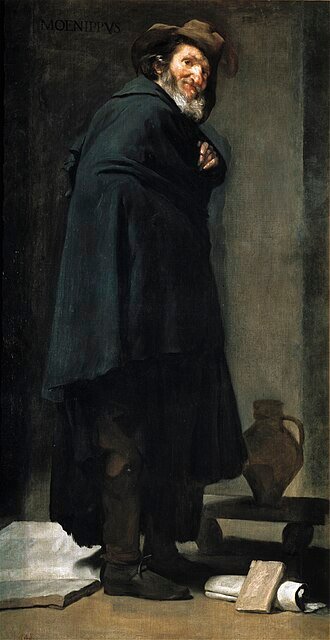
Menippus
299 BC–259 BC · Cynic philosopher and satirist
Menippus of Gadara was a Greek philosopher and writer of the Cynic school, born around 299 BC according to the sources, in the city of Gadara in Coele-Syria. He is traditionally regarded as the inventor of Menippean satire, a genre that alternates prose and verse and blends serious themes with comedy. Although his teaching belongs to the Cynic tradition, it shows traits close to hedonism, and his lasting importance lies mainly in the literary form he created rather than in a detailed philosophical system.
Little is known about his life. According to a tradition recorded by Acaeus, he was a slave of a citizen of Pontus, whom Diocles of Magnesia names as Bato. He later gained his freedom, became a citizen of Thebes and, so the story goes, made and then lost a fortune as a moneylender. Diogenes Laertius also tells of a suicide, but that account is considered unreliable.
None of his works survive complete; only fragments remain. The titles attributed to him include Necromancy, Wills and Letters Composed as if by the Gods, along with pieces addressed to natural philosophers, mathematicians and grammarians. In them he mocked the morals and social habits of his day, and he took aim at Epicureans and Stoics. His Cynicism was combative: it aimed to expose ambition, vanity and the craving for possessions, and he did so with a mocking tone that never abandoned seriousness.
His influence was considerable. Varro wrote his Menippean Satires in imitation of him, and Lucian of Samosata made him a character in dialogues such as Dialogues of the Dead and Icaromenippus. Centuries later, Erasmus of Rotterdam and Bartolomé Leonardo de Argensola also used him as a figure, and Velázquez painted him full length, dressed as a beggar and with a defiant air.
Key ideas
- Menippean satire: a literary form that mixes prose and verse and blends serious topics with comic register.
- Critical Cynicism: a challenge to vanity, ambition and the moral and social conventions of his time.
- Irony toward the schools: mockery of Epicurean and Stoic doctrines, handled with humour rather than systematic treatises.
Curiosities
A portrait by Velázquez
Velázquez painted him full length, dressed as a beggar and with a defiant air, in one of his paintings.
A character for humanists
Erasmus of Rotterdam used him as a character, and Bartolomé Leonardo de Argensola made him the protagonist of his dialogue Menipo litigante, which criticises the legal profession.
Teachers and influences
Teachers
- Crates of Thebes 364 BC–284 BC
Original Filopedia text based on Wikipedia (es) and Wikipedia (en) and Wikidata.