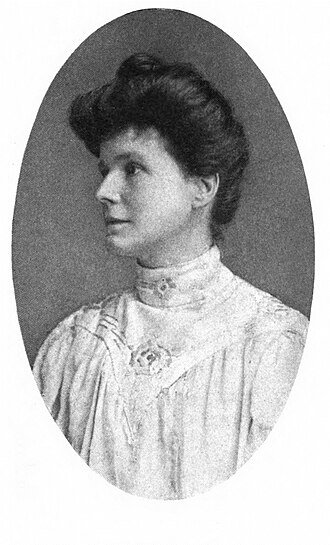
May Sinclair
1863–1946 · British novelist and literary critic
May Sinclair, the pen name of Mary Amelia St. Clair (Rock Ferry, 1863 - Buckinghamshire, 1946), was a British writer active from the late nineteenth century into the mid-twentieth. She published about two dozen novels, along with short stories and poetry, and was also a significant critic of Anglo-American modernism. She is credited with first using the phrase "stream of consciousness" in a literary setting, in her review of the early volumes of Dorothy Richardson's Pilgrimage.
Her father, a Liverpool shipowner, went bankrupt and became an alcoholic, and her childhood was shaped by a strict, religious mother. After a single year at Cheltenham Ladies College she took on the care of her brothers, several of whom had serious heart conditions. From 1896 she supported herself and her mother by writing, often on the position of women and marriage. A committed suffragist, she belonged to the Women Writers' Suffrage League. In 1914 she spent a few weeks at the Belgian front with a volunteer ambulance corps.
Her fiction moved from conventional storytelling toward a more introspective prose, most visibly in Mary Olivier: A Life and Life and Death of Harriett Frean. She also wrote supernatural stories that later critics have admired. Early signs of Parkinson's disease, around 1920, eventually led her to stop writing. Her legacy rests mainly on her part in spreading modernist techniques and on her criticism of her contemporaries.
Key works
- Mary Olivier: A Life (1919), an autobiographical novel using interior monologue.
- Life and Death of Harriett Frean (1922), a portrait of a woman shaped by restraint and duty.
- Uncanny Stories (1923), a collection of supernatural tales.
- The Combined Maze (1913), a novel about a London clerk and the two women he loves.
Books to read
- The Creators: A Comedy EnglishGutenberg
Curiosities
A Jane Austen costume
For a suffrage fundraising event she dressed as Jane Austen, in a demure but rebellious version of the novelist.
A literary term
She is credited with first using the term "stream of consciousness" in a literary context, in her 1918 comments on Dorothy Richardson.
Original Filopedia text based on Wikipedia (es) and Wikipedia (en) and Wikidata.