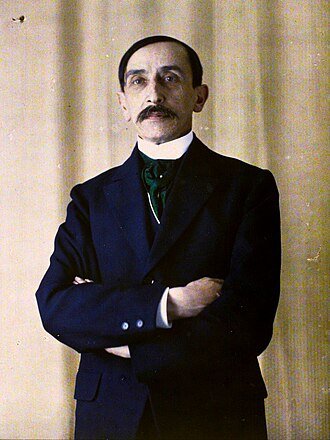
Maurice Barrès
1862–1923 · French novelist, journalist and politician
Maurice Barrès (Charmes-sur-Moselle, 1862 – Neuilly-sur-Seine, 1923) was a French writer, journalist and politician who became one of the most visible voices of French nationalism at the start of the twentieth century. He began as a novelist associated with Symbolism, but his literary themes gradually gave way to a political doctrine rooted in tradition, land and the dead. He matters because his career shows how late nineteenth-century literature could feed into public debates about nation, race and the republic.
He completed his secondary schooling at Nancy and, in 1883, moved to Paris to study law. In the Latin Quarter he frequented literary circles and came into contact with the Symbolist writers of the 1880s. His early books, written in an elaborate and often obscure style, celebrated the cult of the self, an idea that made him known in 1888 and gave its name to his first trilogy. For a time he lived in Italy, where he is linked with Gabriele d'Annunzio.
In 1889 he was elected deputy as a Boulangist, a supporter of General Boulanger, whose nationalism called for revenge against Germany after the Franco-Prussian War. His early individualism gave way to an organic view of the nation, grounded in soil, history and inheritance, which set him against the universalism of the Revolution. The Dreyfus affair marked the turning point: Barrès became a prominent anti-Dreyfusard and published antisemitic pamphlets that are now seen as the most troubling part of his output. He founded short-lived journals and led nationalist leagues, although he never adopted the monarchist programme of Action française, despite his sympathy for its members.
He was elected to the Académie Française in 1906 and sat as deputy for the Seine until his death. During the First World War he backed the Union Sacrée, and in his later years he returned to the Catholic faith. His legacy is divided: he influenced writers such as André Gide and André Malraux and many thinkers of the French right, yet his ethnic nationalism and antisemitism make him one of the most contested figures of his time.
Key works
- The Cult of the Self (1888), the first part of his trilogy on the self, about the pleasures of the senses and the exaltation of personal identity.
- Les Déracinés (1897), the first novel of his Novel of National Energy trilogy, following young Lorrainers who move to Paris.
- Appel au soldat (1900), the second novel of the same trilogy, which deals with the history of Boulangism.
- Les Amitiés françaises (1903), in which he argues that early study of national history should instil patriotism.
- Le Voyage de Sparte (1906), a travel book reflecting his interest in the Mediterranean world.
Books to read
- Trois Stations de psychothérapie FrenchEPUB 93 KBRead online
Curiosities
An avoided duel
During the 1893 campaign in Neuilly, a group of anarchists came to his mansion demanding a duel to answer his campaign posters. Barrès stayed indoors and chose to file a complaint instead.
An ironic nickname
For backing the Union Sacrée during the First World War, the satirical paper Le Canard enchaîné called him the chief of the tribe of brainwashers.
Teachers and influences
Teachers
- Jules Lagneau 1851–1894
Influenced
- François Mauriac 1885–1970
- Charles Maurras 1868–1952
Original Filopedia text based on Wikipedia (es) and Wikipedia (en) and Wikidata.