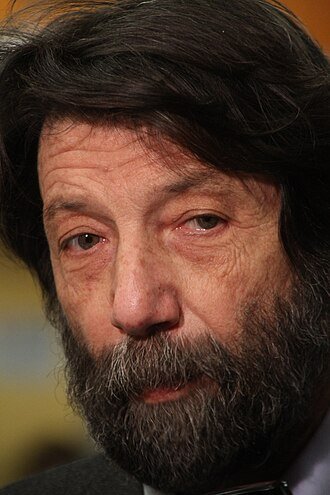
Massimo Cacciari
b. 1944 · Italian philosopher, politician and university professor
Massimo Cacciari (born 1944 in Venice) is an Italian philosopher who also built a long career in politics. Trained at the University of Padua, he is associated with the tradition of "negative thought," drawing on Nietzsche, Heidegger and Wittgenstein, and his work often returns to aesthetics and the crisis of modernity.
He taught aesthetics at the University of Venice, and along the way his path moved from brief contacts with radical leftist groups to membership in the Italian Communist Party. After Berlinguer's death he drifted toward more moderate positions while staying within the centre-left. He served as mayor of Venice from 1993 to 2000 and again from 2005 to 2010. Later he helped establish the philosophy department at the Vita-Salute San Raffaele University in Milan.
His books, including The Necessary Angel and Posthumous People, examine the limits of modern reason, architecture, religious images and the political role of thought. Several of his works have appeared in English translation, which has helped make his ideas known beyond Italy.
Key ideas
- Negative thought: a critique of grand systems that claim to explain reality as a whole.
- Crisis of modernity: the idea that European culture at the turn of the twentieth century anticipated tensions that still shape the present.
- Philosophy of the image: reflection on the icon and religious imagery, drawing on the Russian mystic Pavel Florensky.
- Geophilosophy of Europe: a reading of the continent as a historical and political space rather than a closed cultural unity.
Curiosities
The La Fenice case
As mayor he was indicted for criminal negligence after the 1996 fire at Venice's La Fenice opera house. He was later acquitted of all charges.
Collaborator with Luigi Nono
In the 1980s he worked with the composer Luigi Nono, arranging the philosophical texts for works such as Prometeo.
Original Filopedia text based on Wikipedia (es) and Wikipedia (en) and Wikidata.