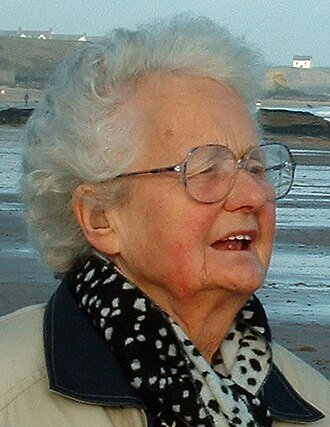
Mary Midgley
1919–2018 · British philosopher specialising in ethics and the limits of science
Mary Midgley (born Mary Beatrice Scrutton in London in 1919, died in Newcastle upon Tyne in 2018) was a British philosopher and senior lecturer at Newcastle University. She is remembered mainly for her work on ethics, human nature and animal rights, and for her insistence that philosophy should engage with science without letting science take its place.
She studied classics and philosophy at Somerville College, Oxford, where she was a contemporary of Iris Murdoch, Elizabeth Anscombe and Philippa Foot. Later commentators have grouped these women together as a significant force in postwar moral philosophy. After the war she took up work of national importance and taught at schools and at Reading University. In 1950 she married the philosopher Geoffrey Midgley, and the couple settled in Newcastle, where she taught from 1962 to 1980, after raising three sons. She began publishing late: her first book, Beast and Man (1978), appeared when she was nearly sixty, and she went on to write well over a dozen more.
Her central argument is that human beings are first and foremost animals, and that our moral life cannot be understood by cutting it off from our biological history. From this she opposed reductionism, the attempt to explain everything in physical or genetic terms, and scientism, the belief that scientific method is the only real source of knowledge. She compared philosophy to plumbing: it goes unnoticed until something goes wrong, and then we must examine the basic concepts we think with. Books such as Wickedness (1984) on evil and Science as Salvation (1992) on science as a modern myth develop this view. She also argued for a moral reading of the Gaia hypothesis and debated Richard Dawkins's ideas about evolution and the selfish gene.
Her influence lies chiefly in debates on animal ethics, the philosophy of biology and the critique of popular scientific claims. She received honorary doctorates from Durham and Newcastle universities, and her autobiography, The Owl of Minerva, appeared in 2005. The Guardian described her as a fiercely combative critic of scientific pretension in Britain.
Key ideas
- Human beings as animals: we are a species of animal, and understanding our morality requires starting from our biology and evolutionary history.
- Opposition to reductionism and scientism: science explains a great deal, but it cannot replace the humanities or answer questions about meaning and value.
- Philosophy as plumbing: its task is to examine the basic concepts we use to think, especially when they generate confusion.
- Evil as the absence of good: wickedness arises from human capacities rather than an external force, and it is countered by cultivating virtues such as generosity and courage.
Curiosities
A late starter
She published her first book, Beast and Man, when she was nearly sixty. She said she wrote nothing until well into her fifties because she did not know what she thought before then.
First winner of a prize against stupidity
In 2011 she became the first winner of the Philosophy Now Award for Contributions in the Fight Against Stupidity.
Teachers and influences
Influenced by
- G. E. Moore 1873–1958
Original Filopedia text based on Wikipedia (es) and Wikipedia (en) and Wikidata.