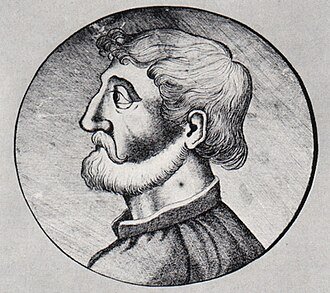
Marsilius of Inghen
1335–1396 · Dutch nominalist philosopher and theologian
Marsilius of Inghen was a philosopher and theologian of the later Middle Ages, born in the Low Countries near Nijmegen. Trained in Paris under Jean Buridan, he is counted among the great nominalists of the fourteenth century, alongside Ockham and Buridan itself, and his work follows the logico-semantic approach of the Parisian school.
The earliest documented event in his life is his Magister Artium lecture in Paris on 27 September 1362. He taught there, served as rector in 1367 and 1371, and drew large audiences. In 1378 he represented the university before Pope Urban VI at Tivoli. After 1379 his name disappears from the Parisian records, probably because of the Schism. In 1386 he became the first rector of the newly founded University of Heidelberg, where he concentrated on theology. He died in Heidelberg in August 1396, only months after his last term as rector.
In logic he was an Aristotelian nominalist, and in natural philosophy an empiricist who still accepted some a priori truths. He held that universals exist only in the mind and that outside it there are only individuals, so scientific knowledge concerns predicates that describe those individuals. Following Buridan, he rejected the Aristotelian account of motion and explained impetus as the transfer of a property from mover to moved. In theology, he argued that natural reason can establish God's existence, but not God's omnipotence or creation out of nothing, which require faith.
His influence lasted. His commentaries on Aristotle became textbooks in many universities, his theology reached Spanish scholasticism, and as late as the sixteenth century people still spoke of a "Marsilian way" in logic and physics.
Key ideas
- Nominalism: universals exist only in the mind; outside it there are only individuals.
- Natural empiricism: knowledge arises from the senses, though some a priori truths are also admitted.
- Impetus: motion is explained as the transfer of a property from the mover to the moved, following Buridan.
- Limits of natural reason: reason can show that God exists, but not God's omnipotence or creation from nothing, which require faith.
Teachers and influences
Teachers
- Jean Buridan 1295–1358
Original Filopedia text based on Wikipedia (es) and Wikipedia (en) and Wikidata.