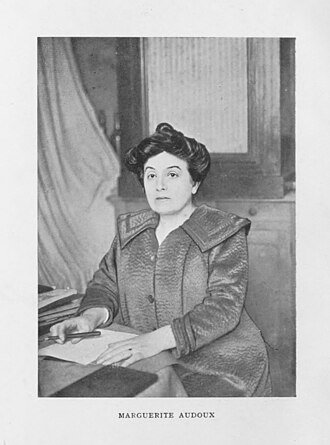
Marguerite Audoux
1863–1937 · French novelist
Marguerite Audoux (Sancoins, 1863 - Saint-Raphaël, 1937) was a French novelist who wrote in the first decades of the twentieth century. She is usually associated with proletarian literature, a current that gave voice to the lives of working people and to urban and rural poverty. Today she is remembered mainly for one successful novel.
She was orphaned at a very young age and spent her childhood in a hospital in Bourges. She later worked as a shepherdess and farm servant in Sologne. In 1881 she settled in Paris, where she survived by sewing and through poorly paid jobs. Around 1895 she had a dressmaking business of her own. Her life took a turn when her niece Yvonne, exposed to exploitation in the Les Halles district, met Michel Yell, who introduced Audoux to a circle of writers and artists and encouraged her to write down her memories.
Those memories became Marie-Claire, which reached the novelist Octave Mirbeau. He wrote an enthusiastic preface and helped bring it out in 1910, the year the novel won the Prix Fémina. Her later books never matched its success, and her output gradually lost momentum. She died in 1937 with little public attention. Her legacy rests on Marie-Claire, a book that quietly portrays the lives of working women and orphaned children.
Key works
- Marie-Claire (1910): her first novel, largely autobiographical, about a childhood orphan's years of service and sewing in Paris.
- L'Atelier de Marie-Claire (1920): a portrait of a sewing workshop and the women who depend on it.
- De la ville au moulin (1926): a novel about a young woman shaped by her parents' separation and family hardship.
- La Fiancée (1932): a collection of short stories published by Flammarion.
- Douce lumière (1937): a posthumous novel about a young woman coping with grief and lost love.
Curiosities
A preface by Mirbeau
The novelist Octave Mirbeau was enthusiastic about the manuscript of *Marie-Claire*. He secured its publication with Fasquelle and wrote a preface for the edition.
The Prix Fémina
Her first novel won the Prix Fémina in 1910, a prize that brought her fame after years spent far from literary circles.
From shepherdess to novelist
Before reaching Paris she worked as a shepherdess and farm servant in Sologne, experiences that became the basis of her first novel.
Original Filopedia text based on Wikipedia (es) and Wikipedia (en) and Wikidata.