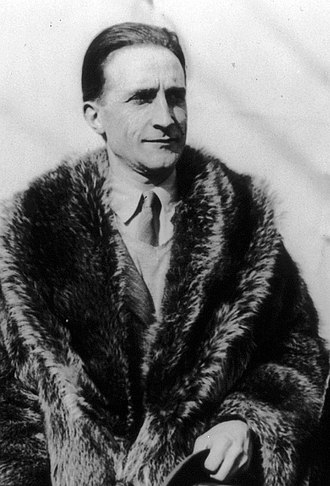
Marcel Duchamp
1887–1968 · French artist and chess player, a key figure of Dada and conceptual art
Marcel Duchamp (Blainville-Crevon, 1887 – Neuilly-sur-Seine, 1968) was a French artist who later became an American citizen, and also a serious chess player. Although he is known above all for his art, his thinking about the act of creation and the role of the viewer places him among the most influential thinkers of twentieth-century art. He is usually grouped with Picasso and Braque as one of the figures who shaped the modern view of art, and his work is seen as a forerunner of several of the more radical developments after 1945.
He was born into a comfortable family: his father was a notary and the town's mayor, and he had six siblings, several of whom became painters and sculptors. As a young man he drew and painted, first in an impressionist manner and later in a style close to Fauvism. In 1904 he moved to Montmartre in Paris, where he lived with his brother Gaston, who signed his work as Jacques Villon. After a brief stint at the Académie Julian, which he left for the cafés, he gained a place in the humorous drawing circuit and exhibited at the Salon d'Automne in 1908.
From 1911 his painting changed course. He became fascinated with depicting movement and the idea of a fourth dimension, and in debate with the Puteaux Cubists he argued for an art that was made in the mind rather than the eye. His Nude Descending a Staircase, No. 2 (1912) caused a scandal: it combined Cubist fragmentation with Futurist dynamism, and at the Salon des Indépendants he was asked to withdraw it or change its title. Duchamp chose to withdraw it, and by his own account the episode made him wary of groups and theories. Afterwards he largely stopped painting and turned to The Bride Stripped Bare by Her Bachelors, Even, a work that occupied him for more than a decade.
His real innovation was to move the centre of art from technical skill to the artist's decision. He held that creation is an act of will and intuition that does not require traditional mastery, and from this came the readymades, manufactured objects he chose and signed, such as the urinal titled Fountain (1917). These works questioned what makes something art and anticipated conceptual art. After the First World War he settled in New York, where he spent much of his life, and gave years to chess as another form of combinatorial thought. His last major work, Étant donnés, was made in secret and revealed after his death in 1968.
His influence is broad. His ideas about artistic intention and the viewer fed conceptual art, pop art and appropriation art, and his questioning of the museum's authority remains present in much contemporary art.
Key ideas
- Art as an act of will: creation depends on the artist's decision more than on manual skill.
- Readymade: a mass-produced object, chosen and signed by the artist, can become art through that decision.
- Retinal versus mental art: he proposed that a work should appeal to thought, not merely to the eye.
- Movement and the fourth dimension: in his 1911 and 1912 works he sought to represent time and displacement as a mental experience for the viewer.
- The viewer as part of the work: the meaning of art is completed by the one who interprets it and by later judgment.
Curiosities
A withdrawn painting
By his own account, he withdrew Nude Descending a Staircase, No. 2 from the Salon des Indépendants rather than accept his brothers' request to remove it or change its title.
From art to the chessboard
He devoted much of his life to chess, which he played competitively.
Teachers and influences
Influenced
- César Aira b. 1949
Original Filopedia text based on Wikipedia (es) and Wikipedia (en) and Wikidata.