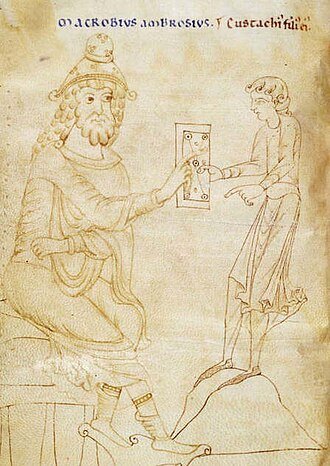
Macrobius
370–430 · Roman writer and grammarian of Neoplatonic tradition
Macrobius was a Roman writer and grammarian working in the Neoplatonic tradition, active in the early fifth century, in the late period of the Western Roman Empire. He wrote in Latin, a language he knew better than Greek, and his importance lies in passing on much of Platonic thought and classical learning to the medieval world through his commentaries and compilations.
Little is known about his life with certainty. Even his name is uncertain: manuscripts record him as Ambrosius Theodosius Macrobius, but in his own time he seems to have been known mainly as Theodosius, and in the Middle Ages he came to be called Macrobius. His birthplace is also unknown. He claims to have been born under a foreign sky, which rules out Italy, and scholars have proposed Latinized provinces such as North Africa, southern Italy, Hispania or Egypt. He held senatorial rank, with the title of most distinguished and illustrious man, which suggests he held high public office. The dates of his birth and of the composition of his works remain debated.
His most influential work is the Commentary on the Dream of Scipio, a gloss on the end of Cicero's Republic that discusses the cosmos, the soul and the afterlife from a Stoic and Neoplatonic viewpoint. In the Middle Ages it was one of the most widely read and cited texts. The Saturnalia, a seven-book and unfinished work, imagines a banquet during the festival of Saturnalia where learned guests discuss history, mythology, grammar and, above all, Vergil. He also wrote a grammatical treatise comparing the Greek and Latin verb, now lost.
His legacy is chiefly that of a transmitter: his books bridged ancient philosophy and medieval thought. His name also survives in astronomy, in the lunar crater named after him.
Key works
- Saturnalia (date uncertain): learned dialogues at a fictional banquet during the Saturnalia festival, with special attention to Vergil.
- Commentary on the Dream of Scipio (date uncertain): a gloss on the end of Cicero's On the Republic that sets out a Neoplatonic cosmology and was widely read in the Middle Ages.
- On the Differences and Similarities of the Greek and Latin Verb (date uncertain): a grammatical treatise comparing the Greek and Latin verb, now lost.
Works in Filopedia
Curiosities
A lunar crater bears his name
The lunar crater Macrobius is named in his memory. An inlet in Antarctica, Macrobius Cove, is also named after him.
A solar calculation
His commentary states that the Sun's diameter is twice that of the Earth, a figure now known to be far off.
A character in fiction
The writer Iain Pears based the protagonist, Manlius, in his novel *The Dream of Scipio* on Macrobius.
Original Filopedia text based on Wikipedia (es) and Wikipedia (en) and Wikidata.