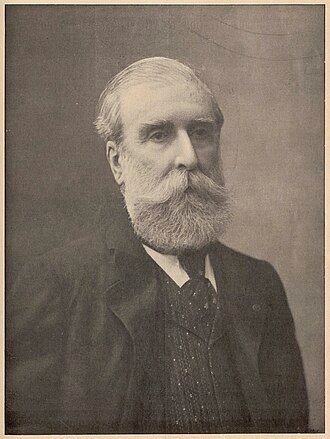
Ludovic Halévy
1834–1908 · French playwright, librettist and novelist
Ludovic Halévy (Paris, 1834-1908) was a French playwright, librettist and novelist, and one of the central figures of the Parisian operetta of the later nineteenth century. He wrote in French and is remembered above all for his partnership with Henri Meilhac, which produced the libretti for Jacques Offenbach's operettas and for Georges Bizet's opera Carmen.
The son of the writer León Halévy and nephew of the composer Fromental Halévy, he combined a career in the French civil service with a passion for the theatre, which he initially hid behind the pen-name Jules Servières. His first collaboration with Offenbach was the one-act piece Madame Papillon (1855). In 1858 he worked on Orphée aux enfers but let his co-librettist Hector Crémieux take the credit and the royalties.
From 1864 he worked with Meilhac, a former schoolfriend, for more than twenty years. Their joint works include La belle Hélène, La vie parisienne and La Grande-Duchesse de Gérolstein. Accounts differ on who did what: Meilhac usually sketched the plot, while Halévy supplied the wit and dialogue, though the exact division is hard to pin down. His style was more measured and craftsmanlike than his partner's. After the Franco-Prussian War and the fall of the Second Empire, Offenbach fell out of public favour, and in 1872 the two librettists took on Carmen, an unusual tragic subject for them.
On his own, Halévy turned to fiction with L'Abbé Constantin (1882) and Criquette (1883), both highly successful. These novels offered a realistic world in which almost all the characters were good and virtuous. The success opened the doors of the Académie française to him in 1884, and from then on he published very little. He also created the Cardinal family, a portrait of the Parisian lower middle class.
His legacy lies mainly in operetta and comic opera, and his libretti are still performed, Carmen above all. His flat on the rue Douai hosted a well-known gathering of painters and writers, and his niece Geneviève Bizet, later Madame Strauss, ran a celebrated literary salon. His sons Élie and Daniel Halévy won recognition as a historian and an essayist.
Key works
- La belle Hélène (1864), with Meilhac and Offenbach: a mocking operetta about the heroes of Homer.
- La vie parisienne (1866), with Meilhac and Offenbach: an operetta portraying Parisian social life.
- L'Abbé Constantin (1882): a highly successful novel with good-natured characters in a realistic setting.
- Criquette (1883): a second successful novel in the same gentle, virtuous vein.
Books to read
- El Abate Constantin SpanishEPUB 167 KBRead online
Curiosities
Credit given away
In 1858 Halévy declined to have his name on the bills for *Orphée aux enfers*, leaving Hector Crémieux with all the credit and royalties.
An opera that borrowed its plot
Johann Strauss's *Die Fledermaus* (1874) plagiarised the plot of their comedy *Le Réveillon*, and the two authors refused to allow it to be staged in France.
A friendship broken by the Dreyfus affair
Edgar Degas ended his friendship with Halévy during the Dreyfus affair, because of Halévy's Jewish background.
Original Filopedia text based on Wikipedia (es) and Wikipedia (en) and Wikidata.