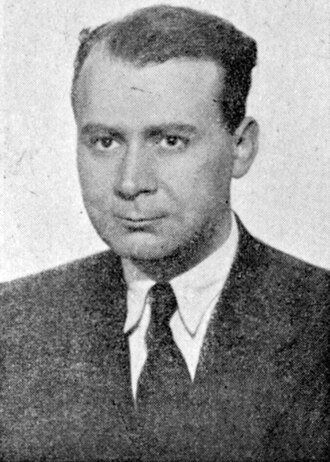
Lucian Blaga
1895–1961 · Romanian poet, playwright and philosopher
Lucian Blaga (Lancrăm, Transylvania, 1895 – 1961) was a Romanian poet, playwright and philosopher, and the first in his country to build a complete philosophical system. Born when Transylvania was part of Austria-Hungary, he belongs to the interwar period in Eastern Europe and is considered one of the major figures of twentieth-century Romanian culture, although he remains little known outside his homeland.
The son of an Orthodox priest, he grew up in a rural setting and was educated in Sebeș and Brașov. After his father's death, and after beginning theological studies to avoid conscription into the Austro-Hungarian army, he moved to Vienna, where he studied philosophy and biology. He earned his doctorate there in 1920 with the thesis «Kultur und Erkenntnis». That same year he married Cornelia Brediceanu, whom he had met in the Austrian capital.
His first collection of poems, «Poems of Light» (1919), was warmly received. Blaga thought of philosophy as a kind of art, hoping to spread his view of the world through suggestion rather than argument. He distinguished between rational knowledge, which clarifies and reduces mystery, and a «Luciferian» knowledge, intuitive and creative, that coexists with what cannot be said. His major theoretical work took the form of three trilogies, on knowledge, culture and values, to which a cosmological trilogy was later added. In the culture trilogy he developed the notion of the «Mioritic space», drawn from the folk ballad «Mioriţa», to describe how the Romanian people relate to death and to the landscape.
His public career was uneven. After failing to obtain a university chair in Cluj in 1924, he entered the Romanian diplomatic service and served in Poland, Czechoslovakia, Switzerland and Austria. He was elected to the Romanian Academy in 1936 and in 1938 became undersecretary of state under a short-lived government. He criticised the racist ideas gaining ground in Romania at the time. After the Second World War the communist regime removed him from the Academy and the university, and he was allowed to work only as a librarian and translator. He died in 1961 and was buried in his native village.
His influence endures in Romanian philosophy and poetry, and the University of Sibiu bears his name today. Outside Romania he remains little known, partly because of the political circumstances that shaped his career.
Key ideas
- Luciferian knowledge: an intuitive, creative way of knowing, opposed to rational and scientific knowledge, which does not dissolve the mystery of the world.
- Mioritic space: a concept describing the attitude of the Romanian people towards death and landscape, inspired by the folk ballad «Mioriţa».
- Philosophy as art: philosophy is transmitted through suggestion and artistic creation rather than through arguments.
- The trilogies of the system: his philosophy is organised into three trilogies (knowledge, culture and values) and a cosmological one, a system meant to encompass the whole of human experience.
Curiosities
A child who did not speak until five
In his own autobiographical account, he did not speak until the age of five. He recalls beginning to talk after a night of inner turmoil, with his hand held before his eyes.
A speech about the village
His acceptance speech at the Romanian Academy in 1937 was titled «In Praise of the Romanian Village», and in it he spoke of a collective, anonymous ancestor.
Teachers and influences
Influenced by
- Johann Wolfgang von Goethe 1749–1832
Original Filopedia text based on Wikipedia (es) and Wikipedia (en) and Wikidata.