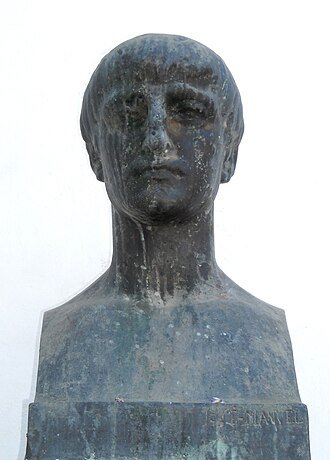
Marcus Annaeus Lucanus, known in English as Lucan (AD 39 - AD 65), was a Roman poet born in Corduba, in the province of Hispania Baetica. He belongs to the outstanding generation of Latin writers of the imperial age, and his short life is remembered mainly for an epic about the civil war between Julius Caesar and Pompey.
Lucan was born into a wealthy family of central Italian origin, in the Roman colony of Corduba. His father, Marcus Annaeus Mela, belonged to the equestrian order, and his uncle, the philosopher Seneca the Younger, took charge of his education, probably with a strong Stoic outlook. Tradition suggests he was precocious, and by sixteen he had already written several compositions. After studies in Athens he returned to Rome at the request of Nero, who made him one of his close friends and honoured him with a quaestorship before the legal age and an augurate. In AD 60 he won a prize at the Neronia, the artistic festival the emperor had founded. The relationship later soured. Nero, who also wrote poetry and envied him, banned his public readings, and Lucan answered with verses hostile to the regime. Around AD 65 he joined the conspiracy of Gaius Calpurnius Piso. When the plot was uncovered, he was ordered to die and chose to open his veins. According to Tacitus, he recited lines of his own about a wounded soldier dying in a similar way, though those verses are lost. It is also said that he implicated his mother under interrogation, a claim that is doubtful, since no trial was ever brought against her.
Only one major work has survived complete: the Pharsalia, an epic in ten books on the war between Caesar and Pompey, which breaks off in the tenth book. Unlike traditional epic, it leaves out divine intervention and aims at a realistic tone, though rhetorical and declamatory effects abound. Its moral hero seems to be Cato of Utica, yet Pompey is treated with some sympathy. The first three books, dedicated to Nero, circulated during his lifetime; the rest appeared after his death, probably because the emperor disliked their anti-monarchical themes. Its legacy was lasting. The poem was read and commented on for centuries, and ancient commentaries survive as evidence of that interest.
Key works
- Pharsalia, an epic in ten books on the civil war between Caesar and Pompey, the only one of his works that survives complete.
- Medea, a tragedy known today only from ancient references to its existence.
- Catachthonion, a lost work of which very little is recorded.
- Silvae, a lost collection of occasional poems.
Works in Filopedia
Books to read
- Pharsalia; Dramatic Episodes of the Civil Wars EnglishEPUB 279 KBRead online
Curiosities
Verses at his death
According to Tacitus, Lucan recited his own lines about a wounded soldier dying in a similar way. Those verses have not survived.
A poem for his widow
After his death, his widow Polla Argentaria kept his memory alive. Statius addressed a poem to her on the occasion of her birthday.
A work dedicated to Nero
The first three books of the Pharsalia were dedicated to Nero, a dedication some read as ironic. The later books, more critical of power, appeared after his death.
Original Filopedia text based on Wikipedia (es) and Wikipedia (en) and Wikidata.