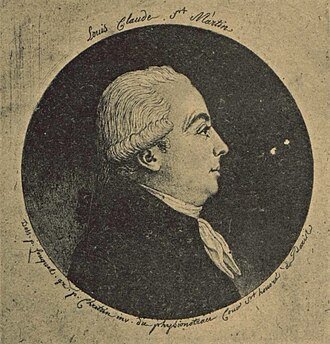
Louis-Claude de Saint-Martin
1743–1803 · French mystical philosopher and freemason
Louis-Claude de Saint-Martin (Amboise, 1743 - Aulnay, 1803) was a French philosopher and freemason, known as 'the unknown philosopher' after the name under which his books appeared. He belongs to the tradition of Christian mysticism and Western theosophy, and his writings were decisive for the rise of the Martinist movement that bears his name.
Born into a family of the lesser nobility, he first studied law at his father's wish and then served in the army, posted at Bordeaux. There he met Martinez de Pasqually, a teacher of mysticism drawn from kabbalistic sources, with theurgic rites. Around 1768 he joined Pasqually's group, the Elect Cohens, and worked as his secretary until Pasqually's death in Saint-Domingue. Soon afterwards he left the army to become a preacher of mysticism.
In Lyon, living with Jean-Baptiste Willermoz, he wrote Of Errors and Truth (1775), his first book, which was later placed on the Index. Over time he drifted from Willermoz's more ritualistic outlook and built his own system, shaped above all by Jakob Böhme, whom he regarded as his second master. He was the first to translate Böhme from German into French.
His thought holds that human beings possess a faculty higher than moral reason, through which they come to know God. Creation flows from an overflowing of divine love; humanity, the immediate reflection of God, fell from its high estate, and matter is one result of that fall. Final regeneration will come through divine love united with humanity in Christ.
He died at Aulnay on the night of 13 to 14 October 1803. His admirers formed circles of 'Friends of St. Martin', and in 1891 Papus and Augustin Chaboseau founded the Martinist Order. His work influenced Joseph de Maistre, Franz von Baader, Schelling, Guénon, Éliphas Lévi and Valentin Tomberg.
Key ideas
- Higher faculty: human beings possess an inner capacity, above moral reason, through which they know God.
- Emanation and fall: God is an eternal personality whose overflowing love gave rise to beings; humanity fell, and matter is a consequence of that fall.
- Regeneration through love: divine love, united with humanity in Christ, will lead to the final regeneration.
- Spiritual Christianity: a critique of ecclesiastical organisation and a defence of a purely inward faith.
Curiosities
An author's alias
His books were published under the name 'the unknown philosopher', which became his best-known title.
A censored book
His first work, Of Errors and Truth, was placed on the Index, although he always remained attached to the Church.
Translator of Böhme
He was the first to translate Jakob Böhme's writings from German into French.
Teachers and influences
Influenced by
- Jean-Jacques Rousseau 1712–1778
- Blaise Pascal 1623–1662
- Emmanuel Swedenborg 1688–1772
- Nicolas Malebranche 1638–1715
- Jakob Böhme 1575–1624
Influenced
- Nikolai Berdyaev 1874–1948
Original Filopedia text based on Wikipedia (es) and Wikipedia (en) and Wikidata.