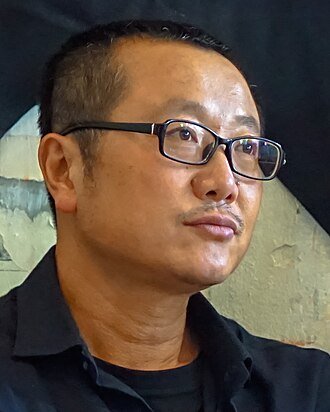
Liu Cixin (born 1963 in Yangquan) is a Chinese science fiction writer and one of the best-known names in the genre in China. He worked as a computer engineer before turning to writing, and his work has become a reference point for contemporary Chinese science fiction, above all through the Three-Body trilogy.
He grew up in Yangquan, in Shanxi province, where his parents had been sent to work in the mines. The Cultural Revolution led to him being sent to live with his grandparents in Henan. He graduated in engineering in 1988 and worked at a power plant in Shanxi, writing his first long novels while on the job.
Liu's writing belongs to the hard science fiction tradition, in which real physics and astronomy underpin the plot. His stories often place humanity inside a much larger and stranger universe, and they ask what role China might play in a future shaped by global forces. His novel China 2185 is credited with earning him the label of the first Chinese cyberpunk author.
The Three-Body Problem, first published in 2006, is his best-known work. It follows a Chinese scientist's contact with an alien civilization and the conflicts that unfold over centuries. Its image of a universe where civilizations hide from one another out of fear sparks reflection on competition, authoritarianism and the risks of science.
He won the 2015 Hugo Award for Best Novel for The Three-Body Problem, in Ken Liu's translation, and he names George Orwell, Arthur C. Clarke and Jules Verne among his influences. His work has inspired adaptations, including the film The Wandering Earth and a Netflix series.
Key works
- The Three-Body Problem (2006): the first volume of the trilogy, about first contact with an alien civilization and its consequences for Earth.
- The Dark Forest (2008): the second volume, which develops the idea of the cosmos as a forest where everyone hides.
- Death's End (2010): the closing volume, with a long-range view of humanity and the universe.
- Ball Lightning (2004): a novel about a little-understood atmospheric phenomenon and the scientific investigation surrounding it.
Where to start
It is the best gateway into Liu Cixin: a science fiction novel with an intriguing mystery, an alien civilization, and detailed yet accessible science. The reader will find a story about Chinese scientists during the Cultural Revolution, a virtual reality game, and a cosmic threat that raises questions about humanity and contact with other worlds.
Next: Death's End. It concludes the Remembrance of Earth's Past trilogy and answers the open questions of the first part with a far-reaching vision of humanity's future.
Works in Filopedia
- The Wandering Earth 2001
- Ball Lightning 2004
- The Three-Body Problem 2006
- The Dark Forest 2008
- Death's End 2010
- The Village Teacher 2012
Curiosities
An electronic poet
Liu programmed «Electronic Poet» (电子诗人), which according to academic Jessica Imbach is probably China's first poetry generator. It imitates the style of the Misty poems of the 1980s.
Writing beside the power plant
While working as an engineer at a power plant, he finished his first two long novels, China 2185 and Supernova Era.
Teachers and influences
Influenced by
- Leo Tolstoy 1828–1910
- George Orwell 1903–1950
- Jules Verne 1828–1905
- Arthur C. Clarke 1917–2008
Original Filopedia text based on Wikipedia (es) and Wikipedia (en) and Wikidata.