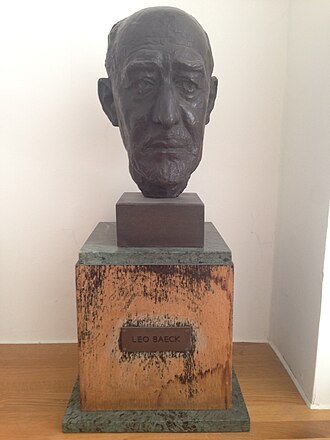
Leo Baeck
1873–1956 · German rabbi, scholar and leader of Reform Judaism
Leo Baeck (Leszno, 1873 – London, 1956) was a German rabbi, scholar and one of the leading figures of Reform Judaism in his country and beyond. He worked in the first half of the twentieth century, a period in which German Jewry went through civic integration, war and Nazi persecution, so his importance lies both in his thought and in his role as a representative of his community.
He was born in Lissa, then in the German province of Posen and now in Poland, the son of Rabbi Samuel Baeck. He trained at the Jewish Theological Seminary of Breslau and studied philosophy in Berlin under Wilhelm Dilthey. He served as a rabbi in Oppeln, Düsseldorf and Berlin, and taught at the Hochschule für die Wissenschaft des Judentums. In 1905 he published The Essence of Judaism, a reply to Adolf von Harnack's What Is Christianity? The book reads Judaism through a neo-Kantian lens softened by religious existentialism, and it made him a well-known advocate for his people and their faith.
During the First World War he served as a chaplain in the Imperial German Army. After the Nazis took power in 1933 he presided over the Reichsvertretung der Deutschen Juden, which tried to protect the Jewish community, and later over its successor under state control. He was deported to Theresienstadt in January 1943, where, according to testimony, his lectures helped many prisoners endure. After the war he settled in London, chaired the World Union for Progressive Judaism and in 1955 became the first international president of the Leo Baeck Institute for the study of German-speaking Jewish history and culture.
Key ideas
- Judaism as an ethical and rational religion: Jewish faith is understood as a living relationship with God expressed through moral conduct.
- Dialogue with Christianity: his work argues that Judaism has its own contribution that deserves recognition beyond the Christian view.
- Neo-Kantianism with religious existentialism: he combines Kantian moral reason with personal religious experience.
- Responsibility to the community: the collective duty of the Jewish people is an essential part of faith.
Curiosities
Protecting his relatives
According to the sources, his position in Theresienstadt allowed him to place some relatives on lists that shielded them from transports.
An asteroid named after him
The asteroid 100047 Leobaeck is named in his honour.
Original Filopedia text based on Wikipedia (es) and Wikipedia (en) and Wikidata.