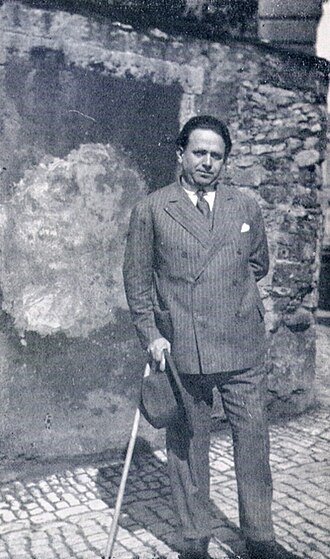
Kurt Tucholsky
1890–1935 · German journalist, satirist and writer of the Weimar Republic
Kurt Tucholsky (Berlin, 1890 – Hindås, near Gothenburg, Sweden, 1935) was a German journalist, satirist and writer who worked during the Weimar Republic. His work became one of the sharpest and most combative voices of those years, known for its criticism of militarism, political reaction and the rise of Nazism.
He was born into a German Jewish family in Berlin, but spent much of his childhood in Stettin, today Szczecin in Poland. After his father's death in 1905, the family fortune allowed him to study law in Berlin and Geneva. He earned a doctorate but never practised as a lawyer. Writing and journalism were what he really wanted to do.
His first real success came with Rheinsberg (1912), a book that broke with the solemn tone then usual in descriptions of the countryside and brought him wider attention. From 1913 he wrote regularly for the magazine Die Schaubühne, edited by Siegfried Jacobsohn, which later became Die Weltbühne. He signed his work with his own name and with several pen names, including Peter Panter, Theobald Tiger, Ignaz Wrobel and Kaspar Hauser, which let him shift voice and tone.
The First World War interrupted his career. He was conscripted in 1915 and sent to the Eastern Front, where he supplied ammunition and later wrote for the trench newspaper Der Flieger. Years afterwards he admitted, rather bluntly, that he had avoided combat as far as he could. That experience fed a firm pacifist and anti-militarist conviction that shaped the rest of his work.
At the end of the war he became editor-in-chief of the satirical supplement Ulk and wrote steadily for Die Weltbühne, of which he was for a time co-editor with Carl von Ossietzky. His articles targeted aristocrats, army officers, reactionary judges, clergymen and opportunistic businessmen, and defended the democratic republic. He also wrote song lyrics and material for Berlin cabarets.
When Hitler came to power, his position became untenable. In May 1933 his books were among those burned, and soon afterwards his German citizenship was revoked. He spent his last years in Sweden, from where he continued to write bitterly about the Germany he had left. He died in 1935 in Hindås, near Gothenburg.
His legacy lies above all in short satire, in the sketch of character and in his use of Berlin speech. He is still regarded as a key figure of German critical journalism in the twentieth century.
Key works
- Rheinsberg: A Storybook for Lovers (1912)
- Dreams by Prussian Fireplaces (1920)
- Castle Gripsholm: A Summer Story (1931)
Works in Filopedia
- Castle Gripsholm 1931
Curiosities
Kafka's verdict
After meeting him in Prague in 1911, Franz Kafka noted in his diary that Tucholsky was a fully formed person at 21. He also remarked that Tucholsky wanted to become a criminal defence lawyer.
A bookshop with schnapps
To promote *Rheinsberg*, Tucholsky and Kurt Szafranski opened a makeshift "book bar" on Kurfürstendamm in Berlin, where anyone buying the book received a free glass of schnapps. The student prank lasted only a few weeks.
The abandoned rifle
In a letter to Mary Gerold, Tucholsky recalled that when ordered to carry an old, heavy rifle on a march, he leaned it against a hut and walked away, and so got through the march unarmed.
Original Filopedia text based on Wikipedia (es) and Wikipedia (en) and Wikidata.