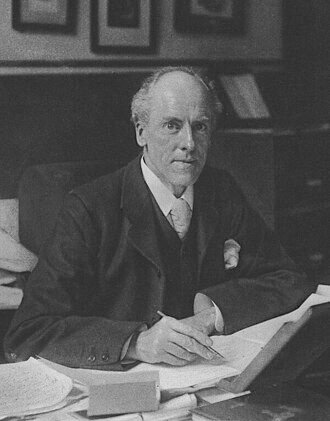
Karl Pearson
1857–1936 · British statistician, mathematician and positivist thinker
Karl Pearson (London, 1857-1936) was a British scientist credited with establishing mathematical statistics and biostatistics as disciplines. His work sits at the meeting point of Victorian science and evolutionary biology. He was also a positivist thinker in the line of George Berkeley and Ernst Mach, and a supporter of eugenics, whose ideas are now seen as an example of scientific racism.
Pearson trained in mathematics at Cambridge and spent part of 1879 and 1880 in Heidelberg and Berlin, studying German literature, metaphysics and Roman law. For years he was a respected historian and Germanist, writing on religion and on Goethe. Around 1884 he turned fully to mathematics, teaching at King's College and University College London, and in 1891 he became professor of geometry at Gresham College. There he began a long partnership with the zoologist Walter Weldon, applying quantitative methods to heredity and evolutionary theory.
That partnership brought him close to Francis Galton, a cousin of Charles Darwin, whose protégé he became and whose biographer he later was after Galton died in 1911. Galton left money to the University of London for a chair in eugenics, and Pearson was its first holder. Heading a department of applied statistics that combined the biometric and Galton laboratories, he trained a generation of researchers and made statistics a basic tool in biology and the social sciences.
His philosophy is set out mainly in The Grammar of Science. He argued that the laws of nature are relative to the perceptual ability of the observer, and that science is largely a classification of the contents of the mind rather than a direct description of an external world. These ideas about relativity and the irreversibility of natural processes caught the attention of Albert Einstein, who suggested the book as the first reading for his discussion group, the Olympia Academy.
Pearson was an atheist, freethinker and socialist, and he turned down public honours, including an OBE in 1920 and a knighthood in 1935. Yet he defended a social Darwinism that applied selection to whole nations and even presented war against so-called inferior races as a natural consequence of evolution. That side of his work clouds his legacy and is now widely criticised. His lasting influence lies mainly in statistical methods, which remain at the core of much modern research.
Key ideas
- Perceptual relativity: the laws of nature depend on the observer's capacity to perceive them.
- Science as mental classification: scientific knowledge organises the impressions of the mind rather than describing an independent world.
- Statistics serving biology: quantitative methods make it possible to study heredity and variation within populations.
- Eugenics and social Darwinism: the improvement of society through selecting the lineages judged fittest, an idea now rejected because of its racist implications.
Curiosities
A change of name
He enrolled at Heidelberg in 1879, and the university's spelling turned his name from Carl into Karl. He used both forms until 1884, after which he kept Karl, supposedly in honour of Karl Marx, whom he had met.
A biography paid for himself
His three-volume biography of Galton, published between 1914 and 1930, was largely paid for from Pearson's own pocket, and he said he wrote it to satisfy himself.
Honours declined
He turned down an OBE in 1920 and a knighthood in 1935, in keeping with his socialist and freethinking convictions.
Teachers and influences
Influenced
- Albert Einstein 1879–1955
Original Filopedia text based on Wikipedia (es) and Wikipedia (en) and Wikidata.