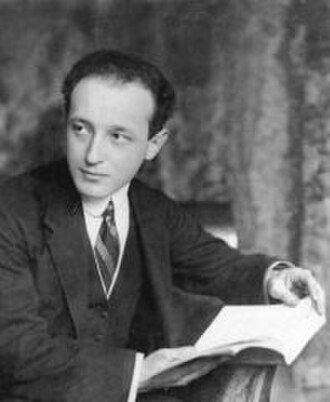
Karl Mannheim
1893–1947 · Hungarian sociologist and founder of the sociology of knowledge
Karl Mannheim (Budapest, 1893 – London, 1947) was a Hungarian sociologist of Jewish descent and one of the central figures of classical sociology. He is widely regarded as one of the founders of the sociology of knowledge, the field that examines how ideas are tied to the social position of those who hold them. His work emerged in interwar Europe and drew on German historicism, Marxism, phenomenology and Anglo-American pragmatism.
He studied philosophy and literature in Budapest and broadened his training in Berlin, where he worked with Georg Simmel, and in Paris. During the First World War he moved in intellectual circles in Budapest, including the Sunday Circle, alongside György Lukács, a lasting friendship even though Mannheim never shared Lukács's conversion to communism. After the brief Hungarian Soviet Republic of 1919 he went into exile in Germany. There he worked with Alfred Weber and, from 1929 to 1933, held a chair in sociology and political economy at the University of Frankfurt. The antisemitic laws of the Nazi regime removed him from his post in 1933, and he fled to Britain. He taught at the London School of Economics and in 1946 became the first professor of sociology at the Institute of Education of the University of London.
His best-known book, Ideology and Utopia (1929), distinguishes between partial and total ideologies. The total kind are comprehensive worldviews tied to particular social groups. He also separates ideologies, which support existing social arrangements, from utopias, which look to the future and may transform society. In his diagnosis of the age, Mannheim saw a shift from laissez-faire toward a planned society, which could end in minority domination or in a renewed form of democracy. To avoid the first, he proposed democratic planning, gradual reform aimed at social justice, and a militant democracy resting on shared values such as freedom, justice and solidarity. He explained the rise of totalitarian systems less by a change of ideas than by the concentration of power made possible by new military, administrative and communication techniques.
His influence can be seen in the sociology of knowledge, the sociology of culture and debates about social planning and education. Some of his students, such as Norbert Elias, later developed their own lines of research, and his ideas are still discussed in analyses of the relationship between ideology, knowledge and power.
Key ideas
- Partial and total ideologies: partial ideologies challenge specific claims, while total ideologies are comprehensive worldviews held by particular social groups.
- Ideology and utopia: ideologies sustain the existing order, whereas utopias look to the future with the aim of transforming it.
- Democratic planning: modern society demands planning, and Mannheim argued that it should be carried out democratically and through gradual reform.
- Social techniques: methods for shaping human conduct can serve social control and encourage centralised power, though they are neither good nor bad in themselves.
- Militant democracy: democracy needs consensus on basic values such as freedom, justice and solidarity.
Works in Filopedia
- Ideology and Utopia 1929
Curiosities
A very young founding member
In 1915 he was the youngest founding member of the Sunday Circle in Budapest, where literary and philosophical topics were discussed.
An offer he could not accept
Shortly before his death he was invited to direct UNESCO, but he was unable to accept the post.
Opposite Freud in the columbarium
His ashes were placed in the columbarium at Golders Green in London. Originally planned to sit opposite Sigmund Freud, Freud was later moved to another location.
Teachers and influences
Teachers
- Georg Simmel 1858–1918
Pupils
- Norbert Elias 1897–1990
Original Filopedia text based on Wikipedia (es) and Wikipedia (en) and Wikidata.