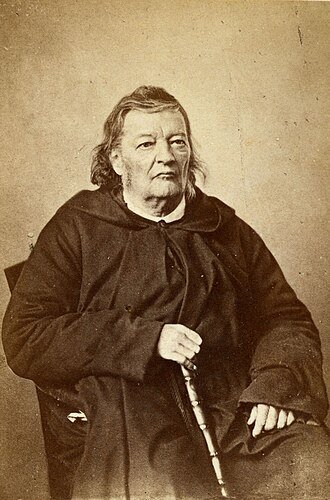
Justinus Kerner (1786–1862) was a German physician and poet, born in Ludwigsburg and closely associated with the town of Weinsberg, where he spent most of his life. He belonged to the late Romantic movement of southern Germany and, together with Ludwig Uhland, Gustav Schwab and Eduard Mörike, formed the group known as the Swabian school of poets. His dual career as doctor and writer shaped his work, and he is remembered today both for his lyric poetry and for his precise early description of botulism.
He studied medicine at the University of Tübingen, where he also pursued literary interests alongside Uhland and Schwab. After earning his doctorate in 1808 he practised in Wildbad, then became a district medical officer in Gaildorf and, from 1818, in Weinsberg. His house became a destination for literary visitors, who were always made welcome. One of the most unusual guests was Friederike Hauffe, a young woman from Prevorst reputed to have clairvoyant gifts, whose story inspired The Seeress of Prevorst (1829), a work that mixes narrative, clinical observation and speculation about animal magnetism and the spirit world.
As a poet, Kerner moved between melancholy and the supernatural, balanced by a folksy, whimsical humour. His poems often deal with natural phenomena, and the same tone runs through his ballads and drinking songs. In medicine he investigated the effects of sebacic acid on animal organisms and described botulism; his experiments with the toxin, which he sometimes tested on himself and on animals, laid groundwork for later therapeutic uses. Around 1851 increasing blindness forced him to give up practice, and he died in Weinsberg in 1862.
His legacy is twofold. As a poet he belongs to the Swabian lyric tradition, and his verse attracted composers such as Robert Schumann, who set twelve of his poems to music. As a physician, his description of botulism is a milestone of nineteenth-century medicine, and his studies of the toxin anticipated its clinical use long afterwards.
Key works
- Travel Shadows (1811): a prose collection of ironic sketches drawn from his own time in Wildbad.
- Poems (1826): the first collection of his lyric verse, later expanded in further editions.
- The Seeress of Prevorst (1829): an account of Friederike Hauffe and the visions attributed to her.
- Picture Book of My Boyhood (1840): memories of his youth between 1786 and 1804.
- The Somnambulant Tables (1853): a study of table-moving phenomena, halfway between investigation and speculation.
Works in Filopedia
Curiosities
A poem set by Schumann
Robert Schumann set twelve of Kerner's poems in his Opus 35, composed in 1840 and dedicated to a doctor friend in London.
A self-chosen epitaph
Kerner chose the inscription on the stone slab over his grave, beside his wife Friederike: 'Friederike Kerner und ihr Justinus'.
Original Filopedia text based on Wikipedia (es) and Wikipedia (en) and Wikidata.