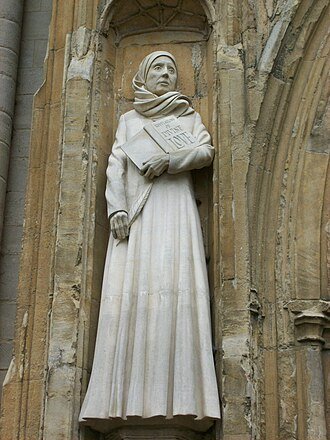
Julian of Norwich
1342–1500 · English mystic and anchoress
Julian of Norwich was an English Christian mystic and anchoress who lived in the city of Norwich during the late Middle Ages. She is regarded as one of England's greatest women mystics, and her writings are the oldest surviving works in English by a woman.
Little is known about her life. She was probably born around 1342 and was alive after 1416. At the age of thirty, in 1373, she fell so seriously ill that she believed she was dying, and during that illness she received a series of visions of the Passion of Christ. After she recovered, she wrote about them, first in a short account and later in a much longer one, known today as Revelations of Divine Love. She lived in seclusion in a cell beside St Julian's Church in Norwich. The mystic Margery Kempe travelled to Norwich to seek her advice.
Her theology is notably hopeful. She speaks of God's love in terms of joy and compassion rather than law or duty. For her, suffering is not a punishment inflicted by God but a means He uses to draw people toward Himself, a view that differed from many who saw the Black Death as deserved punishment. Beyond the reality of hell, she believed there was a greater mystery: the love of God. She uses maternal images for Jesus and God, and this feminine dimension is one of the most original features of her thought.
Her book was not printed until 1670, since the Reformation had prevented its publication. Today she is studied as an important theologian, and her phrase 'All shall be well' has entered English literature, quoted by T. S. Eliot in Four Quartets. Some scholars see her as a forerunner of the Reformation, which is why she is admired in both Catholic and Protestant traditions.
Key ideas
- Divine love: God is presented as love and compassion, not as law or duty.
- Suffering as a means: pain is not God's punishment but a tool He uses to draw people toward Him.
- The motherhood of God: Jesus and God are described with maternal images alongside masculine ones, a highly original feature of her theology.
Works in Filopedia
Books to read
- Revelations of Divine Love EnglishGutenberg
Curiosities
A famous visitor
The mystic Margery Kempe travelled to Norwich to seek spiritual advice from Julian, as recorded in Kempe's book.
A song in her honour
The songwriter Sydney Carter wrote the song Julian of Norwich, which commemorates her optimistic philosophy.
Original Filopedia text based on Wikipedia (es) and Wikipedia (en) and Wikidata.